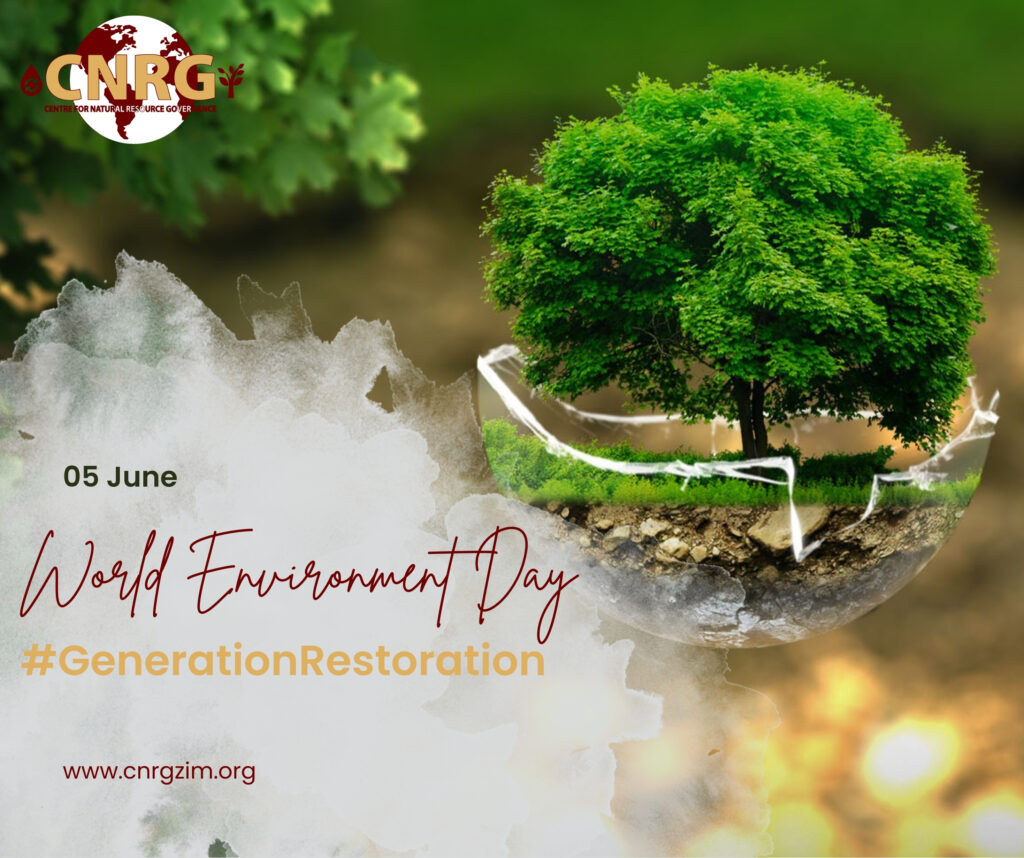
Harare –05 June 2024 – On this day, the Center for Natural Resource Governance (CNRG) joins the rest of the world in commemorating World Environment Day. World Environment Day is an annual event led by the United Nations Environment Programme (UNEP) and is celebrated on June 5 to encourage awareness and action for environmental protection.
The 2024 global theme, “Land Restoration, Desertification, and Drought Resilience” resonates deeply with CNRG’s mission, and the pressing environmental challenges faced by Zimbabwe. The increasing frequency of climate related disasters, with deleterious impacts on the poor and most vulnerable members of society, is a clarion call to action and a stern reminder that if we do not take care of the environment, it will not protect us in the hour of need.
As the world celebrates the importance of healthy, vibrant ecosystems, most Zimbabwean communities are witnessing environmental degradation on a scale never seen in the country’s recorded history. A significant portion of Zimbabwe’s arable land is now rendered unusable due to mining activities. Wetlands are also drying up due to drilling and mining activities. Most mining projects in the country are in the form of open cast, with severe effects on the environment.
Zimbabwe’s natural resources – from its vast woodlands and wildlife to its mineral wealth and water sources – are the foundation of the economy and the lifeblood of communities. Currently, these resources are under increasing threat from unsustainable mining practices, weak governance, and the devastating impacts of climate change.
The country continues to face a range of environmental problems ranging from pollution, mining waste dumps, resource depletion, deforestation, and land degradation, which have become widespread. This is evident in coal seam fires in Hwange, Matabeleland province, the destruction of mountains in Mvuma, Midlands province, and abandoned mine pits in Penhalonga, Manicaland province. Extractive industries appear to be enjoying impunity as there is little effort to ensure land rehabilitation after mining.
Integrating development with robust environmental management has become a major concern. The mining industry thrives at the expense of the environment, posing a serious threat, especially to mining host communities and future generations.
Over the past years, CNRG has documented numerous cases of illegal mining, deforestation, and other environmentally destructive activities that are degrading Zimbabwe’s ecosystems and depriving local communities of their rightful benefits. The organization has also advocated for policy reforms to strengthen natural resource governance and empower citizens to be active stewards of their environment.
Mining, quarrying, and timber logging operations are having a detrimental impact on the environment. These anthropological activities are polluting rivers and streams, damaging wildlife habitats, and contributing to global climate change. Tens of thousands of Zimbabweans have had their land allocated to extractive industries without their knowledge or consent. Additionally, large swathes of land have been designated for exploration and future mining projects.
CNRG calls on government and the extractive industries to:
- Enhance transparency and accountability in the management of natural resources through creation of localized multi-stakeholder platforms to address environmental degradation.
- Allow the Environmental Management Agency to do its work without fear or favor.
- Review the fines imposed by EMA upwards to make them deterrent
- Empower local communities to participate in decision-making and benefit-sharing related to natural resource development.
- Invest in ecosystem restoration initiatives, such as reforestation, wetland conservation, and sustainable agriculture.
- Strengthen environmental laws and their enforcement to curb illegal activities that degrade Zimbabwe’s natural resources.
- Promote environmental education and awareness to foster a culture of environmental stewardship among all Zimbabweans.
For more details, please contact.
Centre for Natural Resource Governance
CNRG Information Department,
Emailinfo@cnrgzim.org
Cell +263 779 078 873
Twitter: @CNRG_ZIM
Facebook:https://www.facebook.com/cnrgzim
Website:https://cnrgzim.org/