
By Staff Reporter
As Zimbabwe positions itself as a key supplier of critical minerals powering the global green transition, local communities are demanding more than promises—they want accountability, justice, and a stake in the energy future.
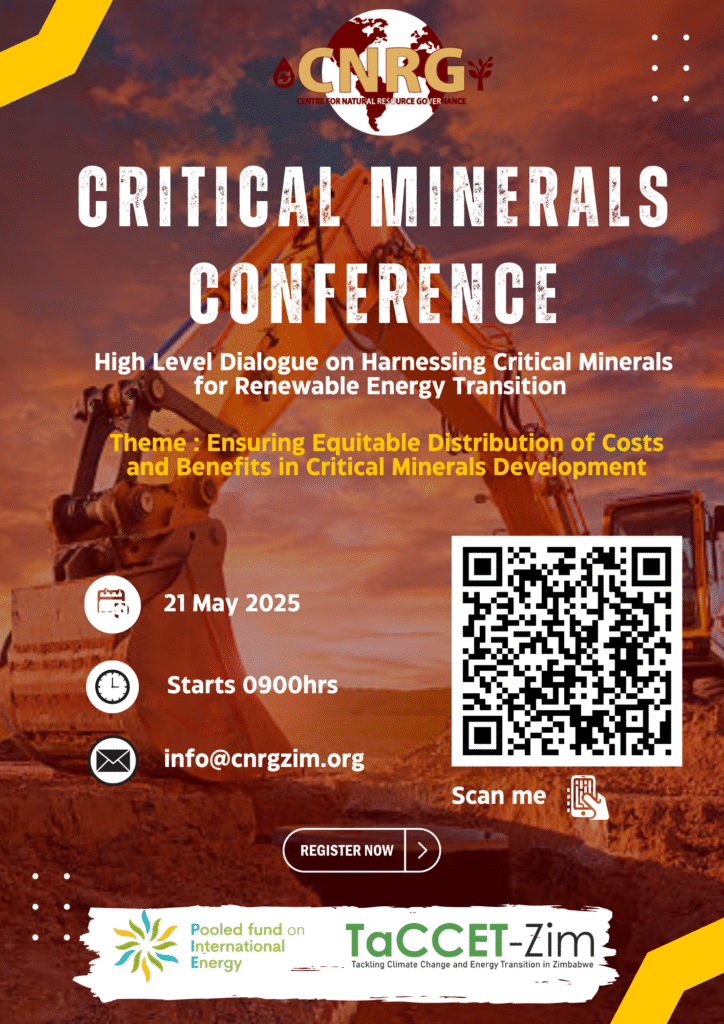
On May 21, 2025 civil society leaders, policy experts, and community representatives will gather in Harare for a landmark conference convened by the Centre for Natural Resource Governance (CNRG). The event, themed “Ensuring Equitable Distribution of Costs and Benefits in Critical Minerals Development,” aims to confront the widening gap between Zimbabwe’s vast critical mineral wealth and the communities left behind.
Zimbabwe is rich in lithium, cobalt, and nickel—minerals that are essential for clean energy technologies like solar panels, batteries, and electric vehicles. Yet, these same communities often suffer from environmental degradation, inadequate infrastructure, and limited access to electricity. Over 60% of Zimbabweans in rural areas remain off-grid, even as their lands provide minerals for a low-carbon future.
CNRG’s approach is justice-drive, calling for the dismantling of Zimbabwe’s extractivist model—one that exports raw materials while leaving mining communities impoverished and infrastructure crumbling under the weight of heavy machinery. Instead, the conference will promote localized value chains, equitable procurement policies, and corporate social investments in renewable energy systems like solar-powered schools and clinics.
“There’s a moral contradiction here,” said Farai Maguwu, CNRG’s founding director. “Communities are being ravaged and sacrificed at the altar of extractive industries. It’s time we expose this harsh reality: these areas have become sacrifice zones—places where people’s rights and livelihoods are stripped away, offering little to no benefit or reciprocity from the industries thriving on their suffering.
He added, “The line between extractivism and responsible mining is crossed when we shift from partnership to ownership, empowering local communities and local miners to participate fully in the value chain.”
This poignant reality underscores the urgent need for a paradigm shift towards more equitable and responsible practices in the extractive industries.
Beyond highlighting community grievances, the event will push for reforms: stronger legal and grievance mechanisms, protection of labor rights, and the integration of local banks and businesses into mining-linked financial flows. CNRG also challenges companies to adopt community equity models, offering ownership stakes in renewable energy projects as a form of reparation and partnership.
As global demand for critical minerals surges—lithium demand alone rose 30% last year—the spotlight is now on countries like Zimbabwe. But the question remains: Will this green revolution uplift the communities who make it possible, or simply repeat old patterns of exploitation under a new name?
CNRG’s conference intends to make sure the former prevails.