
By Staff Reporter
The Southern Africa Trust (SAT) has launched its Zimbabwe Partner Platform, bringing together a diverse network of civil society actors to strengthen collaboration and joint advocacy around climate, gender, and economic justice. Held from July 1–2 in Harare, the inaugural meeting drew participation from key partner organizations, including the Centre for Natural Resource Governance (CNRG), Silveira House, Sivio Institute, Uluntu Community Foundation, Economic Justice for Women Project, and Enviro Press and Women and Land in Zimbabwe among others.
Delivering opening remarks, Janet Zhou, SAT’s Country Manager for Zimbabwe, expressed enthusiasm at finally meeting many partners in person.
“It’s important for us to connect names and voices to the real people behind them. There’s something powerful about being in the same room, getting to know each other’s work and energy, and building relationships grounded in trust and shared purpose.”
Zhou underscored the significance of SAT’s growing presence in Zimbabwe, noting that while setting up has taken time due to contextual and regulatory challenges, the organization is now well-positioned to support meaningful engagement.
“The environment has not been easy,” she noted, citing policy changes such as the PVO Amendment Act and external funding constraints like the U.S. government’s stop-work directive. “But despite these constraints, we are moving forward with a clear strategy and localised action.”
The Partner Platform is designed as a collaborative space to align project implementation with SAT’s overarching SERITI Strategy, which focuses on three intersecting pillars: Climate Justice, Gender Justice, and Economic Justice. The meeting created opportunities for organizations to share their experiences, explore synergies, and co-develop a shared action framework.
“This is not just a workshop. It’s the beginning of a community of practice,” Zhou added. “A space for information sharing, collaboration, and collective advocacy that puts communities and their voices at the centre.”
The convening for the event emphasized the urgency of collective action amid the current Zimbabwean context. Recent legislative developments, such as the gazetting of the Mines and Minerals Bill and the anticipated Climate Change Bill, present critical advocacy moments where unified civil society voices can make a difference.
The two-day program included interactive sessions on monitoring and evaluation, communication strategy co-creation, and discussions on grants compliance and financial reporting. Group work also encouraged deeper reflection on how partner projects intersect with the SERITI pillars, particularly in areas hardest hit by climate shocks, economic exclusion, and gender-based inequality.
Participants reflected on the importance of not only surviving but also sustaining and scaling their work.
“We’re dealing with real people and real challenges,” Zhou said. “So, we must also talk about well-being—about how we support one another and avoid burnout in a difficult operating environment.”
The platform will serve as a mechanism for continuous learning and collaboration, with follow-up meetings, a shared action plan, and a commitment to regional integration of advocacy efforts.
“This is just the beginning,” Zhou concluded. “We want this network to grow. We want to learn from each other, influence more powerfully, and deliver better for the communities we serve.”
In addition to fostering dialogue and knowledge exchange, the platform played a crucial role in strengthening solidarity among partners. Through structured group discussions and collaborative exercises, participants co-created a shared work plan that identifies common advocacy priorities and outlines coordinated actions.
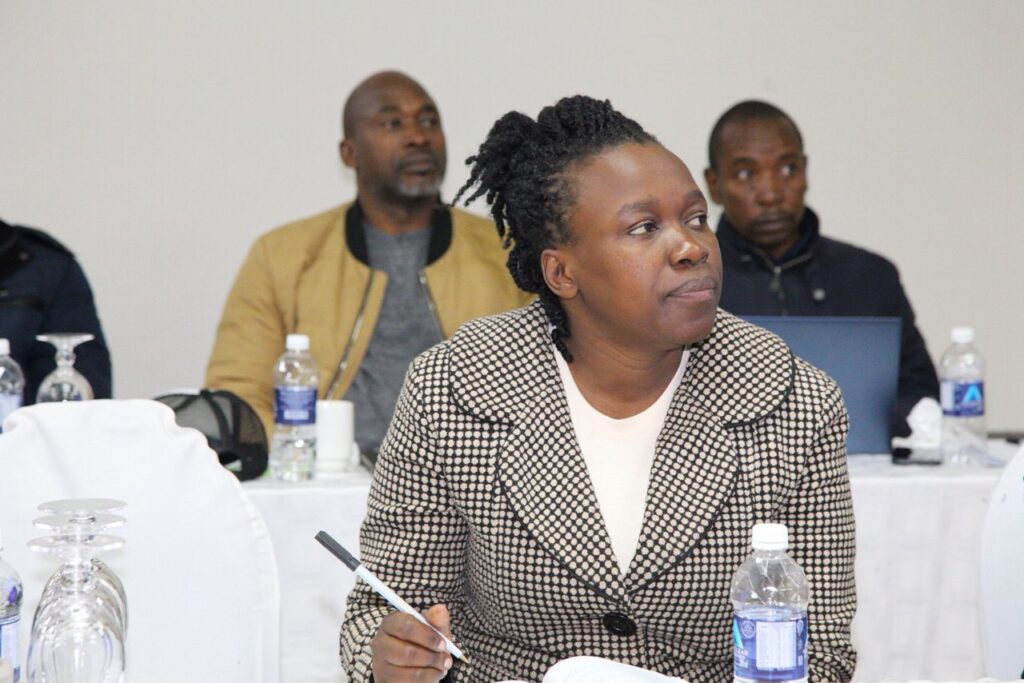
Ndaizivei Garura, Senior Programmes Officer at the Centre for Natural Resource Governance (CNRG).
“This space reminded us that we are not alone in the work we do,” said Ndaizivei Garura, Senior Programmes Officer at the Centre for Natural Resource Governance (CNRG). “The shared work plan is a tool that will help us move in step, amplify each other’s voices, and build resilience as a network working toward justice for our communities.”
This process not only helped surface synergies across different thematic areas but also reinforced the partners’ collective commitment to a unified voice in pushing for social and environmental justice. The shared action framework developed during the meeting will serve as a living document to guide joint interventions, enhance resource efficiency, and deepen strategic coordination moving forward.