
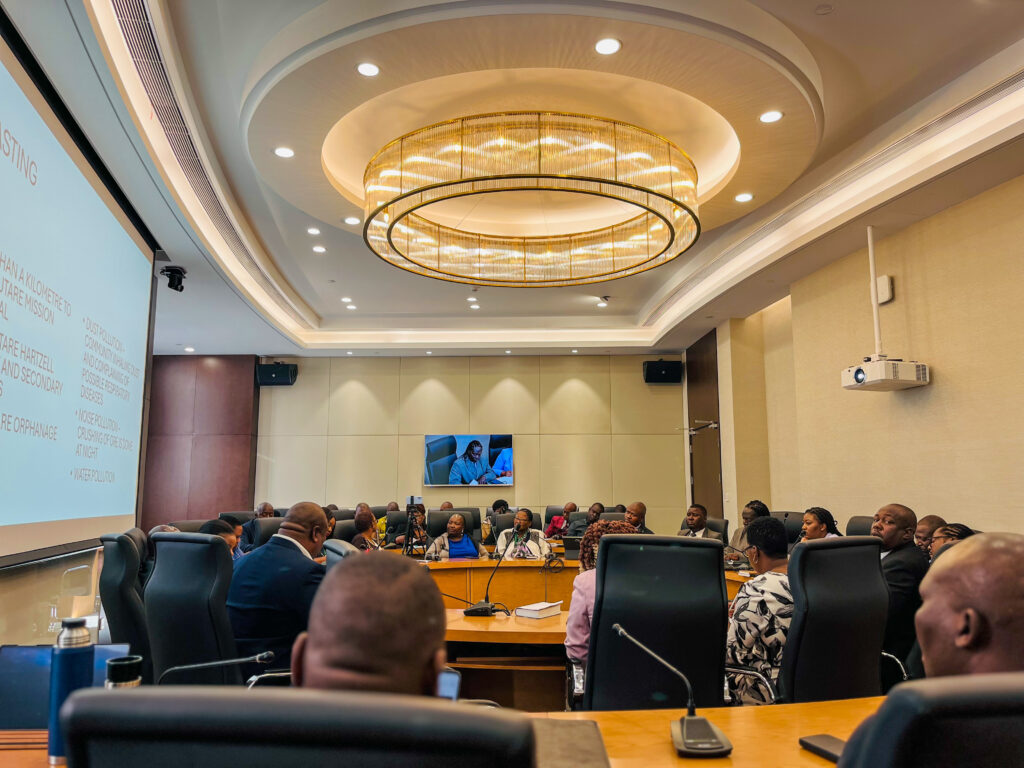
The joint Parliamentary Portfolio Committee on Mines and Mineral Development and the Environment, Tourism and Climate will descend on the Premiere Estates, in Manicaland province on a fact-finding mission to ascertain allegations of irresponsible mining practices.
Following the successful submission of a petition by the Centre for Natural Resource Governance (CNRG) and subsequent oral evidence presentation by executive director Farai Maguwu before the same committees that recently summoned the government departments responsible to appear before them.
Permanent Secretary Pfungwa Kunaka led the Ministry of Mines and Minerals Development team which included the inspectorate department and the Provincial Mining Director Sinobuhle Pimbiwa
EMA was represented by Fanwell Mangisi and Maxwell Maturure who were even chastised for failing to bring a local representative from the provincial office to answer to allegations of mining malpractices along the Mutare River.
Honorable MP, Joanna Mamombe co-chaired the meeting as the head of the portfolio committee for the Environment and Honorable MP Remigious Matangira leads the Mines committee. In her remarks, Mamombe said the two committees agreed to visit the Premier Estate for a fact-finding mission before they make recommendations.
“We have agreed that we have to go to premier Estates with both the Ministry of Mines and EMA on behalf of the Ministry of Environment, Tourism, and Climate to see for ourselves, and then after that our recommendations will be released jointly.
“I have taken note of the issues that have been raised that the Ministry is in full know-how of the illegal mining activities along Mutare River, we will discuss these in our deliberations as to why there have not been actions by the Ministry to stop the mining activities. They are failing to curb the illegal activities and they need assistance from other government departments,” she said.
In a no-holds-barred grilling, the government representatives admitted to failing to manage the mining activities at the Premiere Estates, of both the formally registered and artisanal miners that are causing rampant environmental damage.
Although EMA admitted that riverbed mining operations were outlawed, the Ministry of Mines revealed that the operations of a joint company between the government and Belarus-Zim Gold Fields were allowed for a specific reason under a special grant.
PS Kunaka said the Special Grant was given to the joint venture company under strict conditions of adherence to rehabilitation, desilting, and restoration of the Mutare River, which that company has failed to do.
Zimbabwe Mining Development Corporation (ZMDC) represents the government’s interests in the joint venture vehicle created to exploit the alluvial gold deposits.
“We are not fully satisfied in terms of the progress and achievements of ZimGold Fields. Much more is expected to come out of this project. There are some instances where we have seen a lot of illegal mining taking place, it is not just illegal, but it is also being done irresponsibly.
“Zim gold fields, we have a partnership, what this has is a mining title called a special grant. It is not the only special grant that this company has, under this grant they are allowed to mine within the riverbed under strict conditions,” said Kunaka.
Alluvial gold mining is banned under a 2013 cabinet directive which was further empowered by a 2014 Statutory Instrument refined and approved in 2018.
“It is government policy that riverbed mining stands banned in the country, when I say banned, it is universal across the country. We started with this ban at the cabinet level in 2013 cabinet took a position that because of the sensitivities in the riverbeds we needed to protect the rivers so the government took a position to ban riverbed mining.
“There are some exceptions out of the ban there was a decision to allow a few operators in the mining sector to undertake riverbed mining,” said Kunaka.
“…Our policy is not regionalised but applies across the country. We are guided by the Act of Parliament, which is the Mines and Mineral Development, and we are currently amending it to be a sharper law.
“EIA is a must to inform the feasibility of the mine operations- it is a requirement, and all our miners are expected to have that. In the case of artisanal miners, we expect one to have an EMP. So, no one is exempt from the tenets of managing the environment, everyone is bound by that…”
On the part of EMA, Mr Mangisi said during routine monitoring inspections on site Zim Gold Fields has been fined with tickets and slapped with environmental protection orders for violating the environmental regulations.
He said the department was alerted of these violations by the community after the firm was licensed to carry out a pilot alluvial mining under government guidance in 2021 which expired in January 2024 pending renewal to align with the recommendation of the SI.
“We noted the complaints of the community- they were also subcontracting we noted violations that were done by Zim Gold Fields and other contractors. There are still illegal operations that are still being undertaken even by mechanized mines and our locals and illegal miners.
“We have noted degradation when it (alluvial gold mining) started in 2011, in 2018 we also noted degradation, even the monitoring inspections as we monitored ZimGold Fields (from 2021) we noted degradation the evidence of environmental protection orders and tickets its an indication of violations,” said Mangisi.
The Ministry of Mines however sought to downplay the devastating operation of reef miner Sino Africa stating that their operations were within the law despite a record of blasting disturbances by the community which destroyed property.
The ministry says this was ‘an isolated incident in 2022 when blasting operations disturbed the community and destroyed a goat pen’. Despite further claims that the matter was settled, affected villagers which The Weekly has on record state that they have hit a brick wall in their engagements with Sino Africa.
Sino Africa also stands accused of cyanidation leaching and forging community signatures in their EIA document- matters that have been raised by the community and singled out in the petition but both government departments failed to properly address during the parliamentary hearing.
The petition by CNRG prayed the Parliament of Zimbabwe to exercise its oversight role, on administrative bodies and ministries charged with monitoring and evaluating the implementation of mining development policies; regulating the management of the environment, and promoting, coordinating, and monitoring the protection of the environment, and ensure the rampant unsafe mining practices taking place at Premier Estate are stopped for the safety of residents and preservation of the environment.
At least 21 households that own smallholder plots are affected by the ongoing activities and oppose the continued irregular extraction of gold by artisanal miners and several other mining companies including Zim Gold, Chinese company Xu Zhong Jin Investments, and Climex Sino Africa Huijing Holdings.