
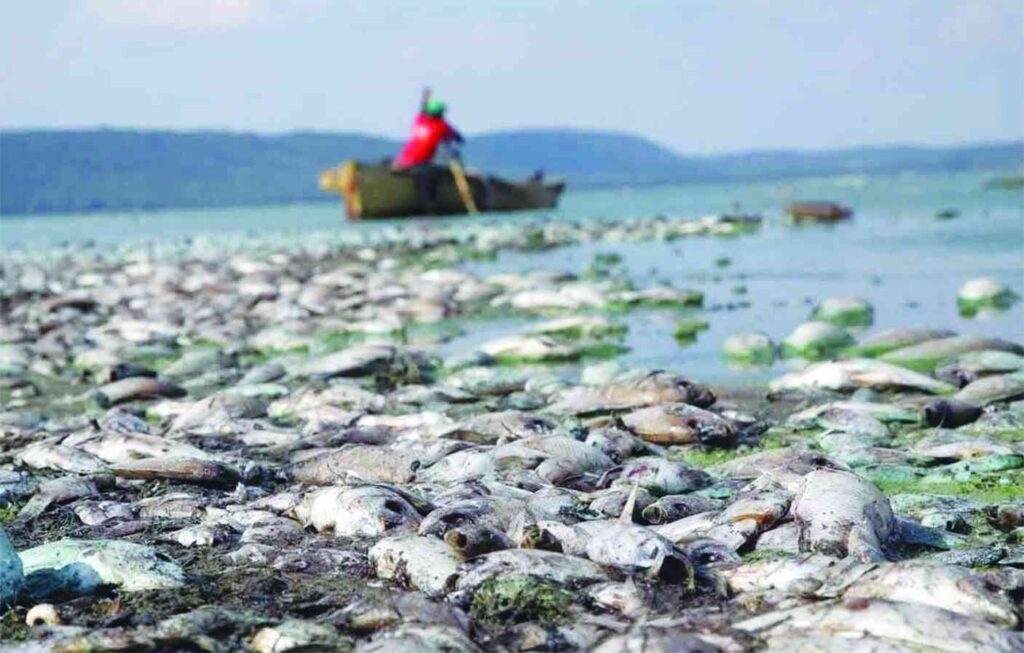
Environmental and Wildlife Regulatory bodies are under fire as pollution at the lake, which supplies water to Harare, claims several wildlife, including protected Rhinos and aquatic life, as environmental degradation worsens in the country.
By Staff Reporter
The environmental crisis in Zimbabwe has reached alarming levels, with widespread pollution and degradation of natural resources threatening the health and livelihoods of millions of citizens. At the heart of the crisis is the failure of regulatory bodies, such as the Environmental Management Agency (EMA), to effectively enforce environmental laws and protect the country’s natural resources.
The situation is particularly dire at Lake Chivero, according to the Zimbabwe Parks and Wildlife Management Authority (ZIMPARKS) spokesperson Tinashe Farawo, where pollution has killed four rhinos due to water contamination caused by cyanobacteria- a toxic algae linked to pollution.
Unfortunately, the rhinos aren’t the only victims – three zebras, four wildebeests, fish eagles, and even livestock from nearby farms have also succumbed to the polluted waters, while the lake’s water remains undrinkable, posing a serious health risk to the surrounding communities.
Speaking during a recent radio show on Zi FM stereo, legal experts, environmental activists, and conservation experts, effectively condemned the lack of urgency in addressing environmental emergencies and violations.
During the show director of the Centre for Natural Resource Governance (CNRG), Farai Maguwu made a bold call for a collaborative approach to addressing the crisis, involving government agencies, civil society organizations, and local communities.
Maguwu stressed that the Lake Chivero crisis extends far beyond environmental degradation, posing a direct threat to human security and well-being. With millions of Zimbabweans unable to access affordable clean water, they are forced to rely on contaminated sources, exacerbating the crisis.
He attributed this crisis to a lack of governance, where regulatory authorities are not willing to take responsibility, and instead, supervisory establishments engage in blame-shifting.
“We’re not just talking about environmental degradation, we’re talking about human security,” said Maguwu “Millions of Zimbabweans cannot afford to buy clean water, and they’re forced to drink from polluted sources like Lake Chivero.”
“It’s a crisis of governance. No one wants to take responsibility, and finger-pointing among regulatory authorities has become the norm.”
The crisis is not limited to Lake Chivero. Across the country, mining companies are polluting rivers and streams, destroying ecosystems, and threatening the livelihoods of local communities in areas like Penhalonga, Shurugwi, Mutoko, and Hwange.
“It’s a national crisis,” said Maguwu “We need to take immediate action to address the environmental carnage, degradation, and pollution that’s happening across the country.”
“We need to work together to protect our environment and ensure a sustainable future for all Zimbabweans.”
In the meantime, the people of Zimbabwe continue to suffer the consequences of environmental degradation and pollution, this crisis demands immediate attention and action from the government and regulatory bodies.
Such action should start with legal reforms to ensure that the justiciable environmental rights can be enforced with clearly laid out noncompliance consequences said a legal expert Tinashe Chinopfukutwa with the Zimbabwe Lawyers for Human Rights (ZLHR).
He said the fines imposed on entities responsible for massive pollution are grossly inadequate and fail to reflect the severity of the environmental damage caused.
“There is also an issue of legal reform. For instance, I mentioned that in terms of section 10 of the Environmental Management Act, EMA is empowered to issue environmental protection orders.
“But the law does not lay out the consequences for failure to comply with those environmental protection or orders. So, then that leaves EMA as a toothless entity. It is powers to issue those orders, but then it is not armed with powers to enforce those orders effectively.
“It (EMA) can issue fines, but sometimes those fines are ineffectual.”
EMA has been criticized for failing to enforce environmental laws and protect Zimbabwe’s natural resources effectively and Maguwu calls for a radical solution, its disbandment and reconstitution.
He said many regulatory bodies have been compromised, with staff prioritizing political loyalty over their mandate, and failing to address critical economic and environmental issues.
“One thing we should start talking about now is also the disbanding of institutions like EMA. I don’t understand what role they are still playing today and I think there is a need for a reconstituting of regulatory authority with a new mandate, a new resolve, and new people.
“Most of these regulatory authorities are now staff to the politicians, who are there largely to appease the powers that be so that they remain in their jobs.”
EMA spokesperson Ankele Sidanke remains adamant that they serve a critical role in enforcing environmental compliance within their given mandate stipulated by the law and have been effectively discharging their duties.
“So what I can basically say is (that) the agency has been using, whatever is before us as is provided for in the law that it is enforcing, yes we appreciate that at times the public will want the agency to go outside what it is intended to do.
“The agency will always make it a point that we do everything that is that we were capable to do within the law that we are enforcing and that we are equal to the task,” said Sidanke.
According to EMA, at least 450 mega million litres of raw sewage are discharged into the environment daily in Zimbabwe, with the greater Harare district discharging 250 mega litres of this- which seeps into the environment.