
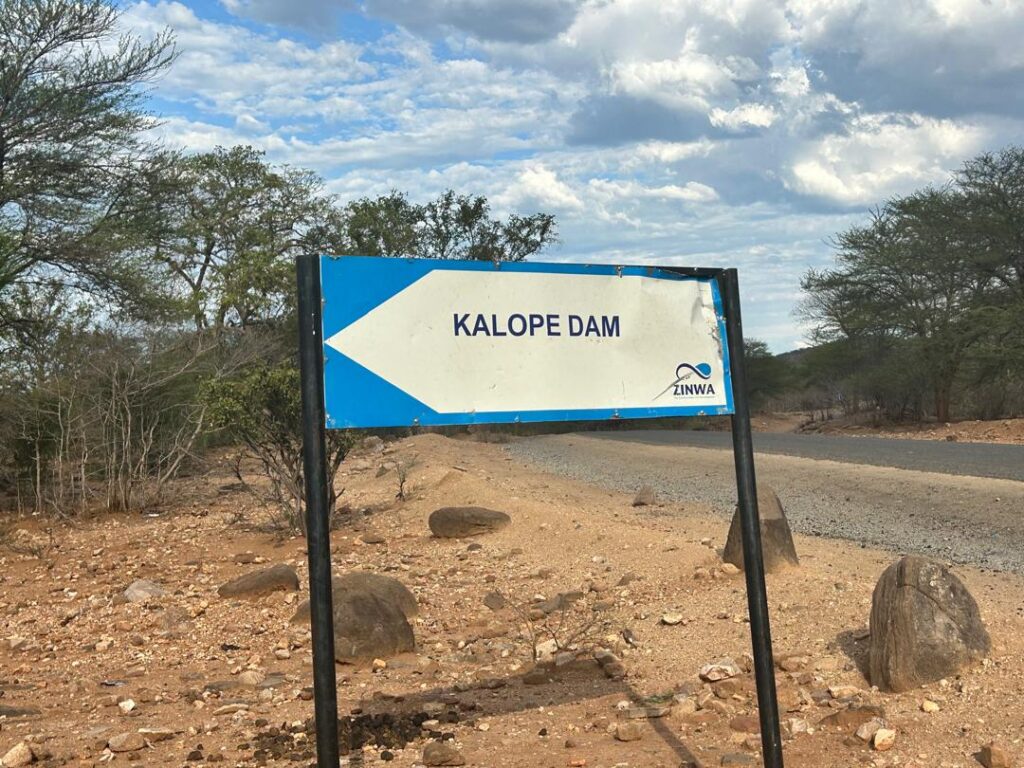
Crisis brewing at Kalope Dam as a power plant and mining activities threaten the livelihoods of 282 families under the Lukosi Irrigation Scheme in Diki Village, Hwange.
By Staff Reporter
Community leaders in Diki Village, Hwange, are taking decisive action to address a devastating crisis at Kalope Dam, the primary water source for the Lukosi Irrigation Scheme. The dam’s four tributary streams have been obstructed by two Chinese mining companies operating in the area.
South Mining’s Mutargech division and Zimbabwe Zhongjing Heli Energy Pvt Ltd (ZJHL), have also drilled eleven boreholes reportedly 280 meters, and laid a pipeline to divert water to their mine sites.
This has resulted in severe water scarcity, threatening the livelihoods of 282 families who depend on the irrigation scheme.
As the fate of the Lukosi Irrigation Scheme and the livelihoods of hundreds of families hang in the balance, community leaders have taken immediate action to prevent a collapse of the scheme working together with a local advocacy civil society organization.
According to the executives of the Irrigation Management Committee, the scheme produced 30 metric tonnes of wheat for the Grain Marketing Board in September and benefits over five thousand locals.
The community has expressed concerns over the environmental implications of the water diversion, including the destruction of aquatic ecosystems and disruption of natural water flows.
Village head Peter Mpala confirmed the community’s struggles to engage the mining companies and appealed for urgent intervention.
“We are appealing to the relevant authorities to unblock the tributary streams to allow water to flow into the Kalope Dam and halt construction of the pipeline diverting water to the mine site. Our engagement with the mining companies has not been fruitful,” he said.
The Centre for Natural Resource Governance (CNRG) is working with the community and a team has visited the site of the blocked tributaries to assess the situation and assist the urgent address of this crisis.
Ndaizivei Garura, CNRG officer said there is a need to conduct an on-site assessment to guide possible solutions to the crisis which threatens the sustainability of the community irrigation scheme.
“As an organization, we advocate for justice and dignity for communities impacted by extractive industries, we are building community agency for local leadership to seek redress on corporate excesses.
“The precarious situation of the Kalope Irrigation Scheme is a pressing concern that not only threatens livelihoods but also raises questions about the social responsibility and legitimacy of mining companies to operate in these areas,” she said.
CNRG has produced reports on mining investment including a recent publication that critically examines the nature of investments and Chinese mining operations in Zimbabwe and their impacts on host communities.
The research investigates key aspects essential to any mining enterprise, including environmental impact, labor rights, and the observance of the sociocultural rights of host communities. It also highlights how Chinese mining ventures have led to widespread environmental degradation, disregard for the cultural rights of host communities, and, in many cases, the violation of the country’s labor laws, often with apparent impunity. ZJHL has been actively involved in various energy projects in Zimbabwe, including a 300 MW coal-fired thermal plant in Hwange to support energy self-sufficiency in meeting increasing power demands and reducing load shedding.