By Staff Reporter
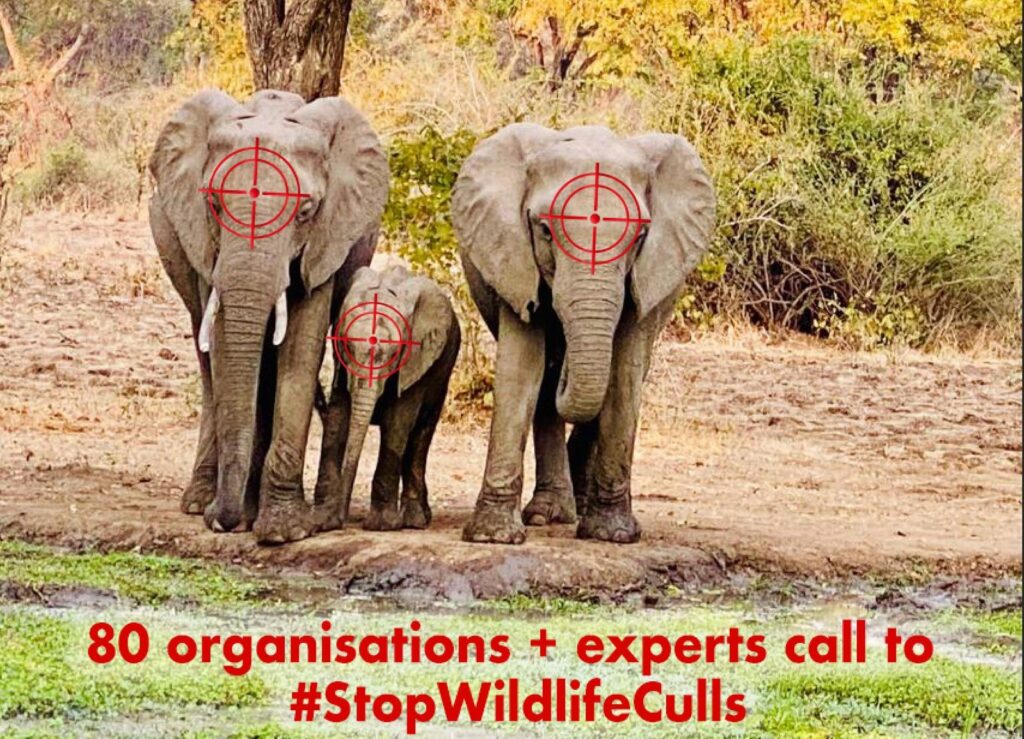
At the heart of our recent publications in The Weekly is our continued coverage of elephant culling in Zimbabwe and Namibia- with a special report in this edition we highlight how several civic society organizations speak out against the proposed culling of elephants across the globe. A massive 80 civic organizations, conservation groups, and animal rights advocates argue this assault on wildlife is not only ill-advised but ultimately serves the interests of those who benefit from the commercial exploitation of threatened wildlife populations.
In a joint Press Statement, the Centre for Natural Resource Governance (CNRG) joined forces with various NGOs to express deep concern regarding the recent proposals from Namibia and Zimbabwe to cull large numbers of elephants and other wildlife. The essential characteristic of the message and the ultimate force propelling it forward—one that is on full display in the statement- is skepticism over the lack of transparency around the whole issue. The organizations demand that both governments be accountable for their actions, which is not a demand out of the ordinary.
While the track record of government impunity and mismanagement in Zimbabwe has become recurring, the statement still extends an olive branch for the government to take a more open approach. It states that ‘there are more sustainable and humane alternatives to address the challenges faced by both people and wildlife’ even as Sub Sahara Africa reels from a devastating El Nino-induced drought.
The justifications for the culling exercise include a combination of providing meat to drought-stricken citizens, reducing pressure on land and water resources, mitigating human-elephant conflict, and reducing alleged wildlife overpopulation. If the culling was a testimony to government enterprise feed its hungry masses or wildlife conservation efforts, the implementation of this exercise should have been well thought out and sustainable. At a cursory glance it is reactive at best and at worst embodies the deepening levels of incompetence in the governance infrastructure.
In the solidarity message in the presser the NGOS state their collective concern, “We are concerned that the proposed culls may ultimately serve the interests of those who stand to benefit from the commercial exploitation of threatened wildlife populations.”
“We note that experts have suggested several rational and sustainable alternatives to address the effects of the drought, most importantly the provision of staple food such as grain to ensure food security.14 15 Also, a wide range of measures and policies are available that have been proven to be effective in preventing and solving human-wildlife conflict without resorting to the indiscriminate killing of wild animals. These measures should be explored and implemented before any lethal interventions are considered.
“We call on the governments of the countries concerned to withdraw plans to cull elephants and other wildlife, and instead to use their available resources to implement existing, well-proven alternative, sustainable, and humane measures to tackle the current challenges facing both people and wildlife.
“We also call on donor governments and agencies to link the provision of aid to the implementation of effective and sustainable measures to ensure food security and human-wildlife coexistence, while also protecting increasingly threatened wildlife populations,” reads part of the statement.
It should be noted that the culling of elephants is not a novel idea, nor a successful conservation model, but represents a major policy reversal. It was carried out in Zimbabwe and South Africa between the mid-1960s and the mid-1990s but was abandoned after heavy criticism because of the cruelty and trauma inflicted on these highly intelligent and social animals.
The civic society, conservation and wildlife groups also debunked claims of overpopulation peddled by the Zimbabwe Parks & Wildlife Management Authority (ZimParks), stating that there has not been any significant population increase since 2014 in Africa. The endangered jumbos have dwindled in the last five decades.
“African savanna elephants are categorized as Endangered in the IUCN Red List of Threatened Species. Their populations have declined by at least 60% across the continent over the last 50 years.8 While southern Africa has been less affected by these declines and is home to the largest populations of savannah elephants, claims of recent population growth and over-population have no scientific basis. Recent studies show that the populations in southern Africa have remained largely unchanged since 2014.”