

By Staff Reporter
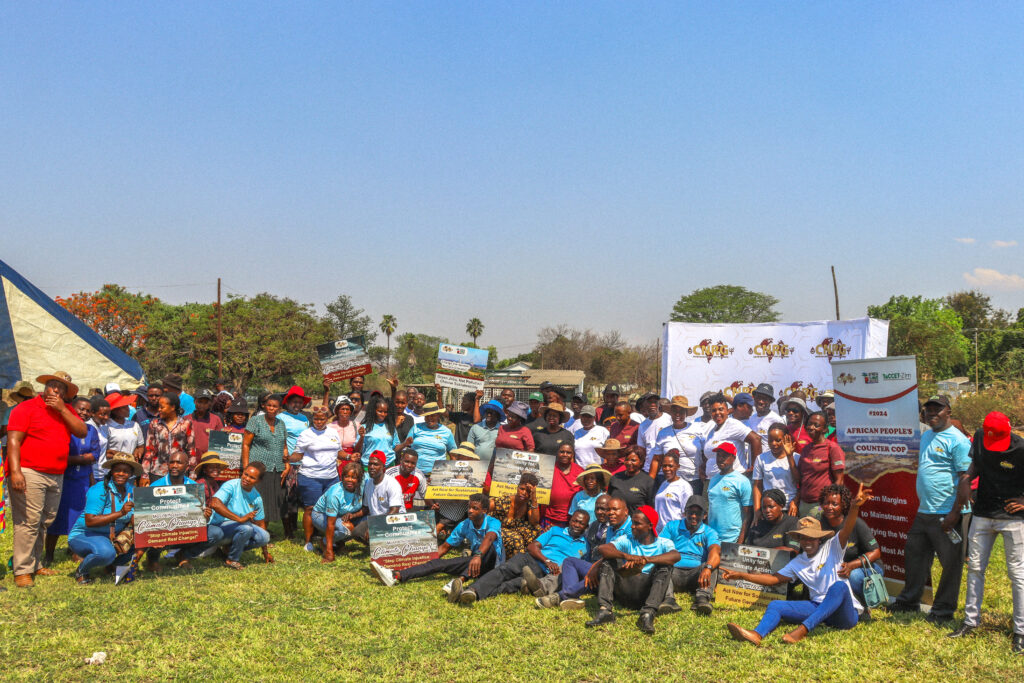
The Centre for Natural Resource Governance (CNRG) recently convened the 2024 #AfricanPeople’sCounterCOP in Hwange, which brought together diverse organizations committed to advancing climate justice. Vital discussions centered on Just Energy Transition and Climate Justice.
The annual event is a platform for amplifying community voices and addressing the urgent realities of climate change affecting various regions of Zimbabwe, from Manicaland to Matabeleland provinces. It is an alternative space modelled by the civic society around the ideals of the Conference of Parties (COP) to engender the inclusion of communities in the climate change discourse.
It builds on the momentum, of the inaugural African People’s Counter COP (APCC) convened by the African Climate Justice Collective (ACJC) in Saly, Senegal. The groundbreaking event marked a pivotal moment for African voices, often marginalized in international climate discussions dominated by Global North states and corporations.
Themed “Africa United Against Systematic Oppression and Climate Injustice,” the African Counter COP captured the voices of vulnerable communities that face the brunt of climate change but are largely excluded from discussions of how to address the crisis.
COP conferences organized under the United Nations Framework Convention on Climate Change (UNFCCC) have faced a backlash from critics for being elitist and stalling on reforms in addressing an ecological debt by the Global North- whose vast industrial complex greenhouse gas emissions have largely caused the climate crisis.
CNRG’s Executive Director, Farai Maguwu, provided a compelling overview of the global climate crisis and its impact on vulnerable Global South nations like Zimbabwe.
He stated, “Climate change is not merely an environmental issue; it is fundamentally a matter of justice. We must recognize the unique challenges faced by different communities across our nation.
“It is a human and political crisis whose burden is unequal as often those most vulnerable to climate change bear the burden on their own. At times even their governments are not there to help them mitigate the risks associated with climate change.
“In the Global South, the effects of climate change are felt disproportionately. Despite not contributing much to the emission of greenhouse gasses into the atmosphere, still, our people are at a greater risk.”
Maguwu said local manifestations of climate change which include rising temperatures, struggles with coal seam fires, human-wildlife conflict, Cyclones, and the El Niño induced drought are critical concerns that require immediate attention.
He said, “The concept of Climate Justice although it accepts the global nature of this crisis questions how the burden of mitigation and adaptation is being shared. We need to raise awareness and demand from the authorities, without fear, that they have a duty and responsibility to address this climate crisis.”
Addressing Vulnerabilities
During the discussions, Tracy Mutowekuziva, CNRG’s Programs Manager, highlighted the organization’s efforts to tackle the vulnerabilities exacerbated by climate change. “We are engaging communities to understand their unique circumstances and to develop tailored solutions that enhance resilience,” she said.
She underscored that food insecurity is emerging as a key focus area- as food systems have become stretched- affecting both rural and urban communities where in Zimbabwe, “In the face of the climate crisis, we need to redefine what it means to be food secure. It’s about ensuring that communities have access to sustainable agricultural practices and resources.”
The Role of the Private Sector in Just Transition
The Counter COP also emphasized the vital role of the private sector in the Just Transition. “Businesses must recognize their responsibility in fostering sustainable practices that align with community needs,” Maguwu stated.
“By collaborating with local communities, the private sector can drive positive change and contribute to a more sustainable future. Our demands focus on the role of the private sector in assisting communities in adapting to climate change by investing in renewable and green energy. This is the work that we are taking up as the TaCCET coalition.”
Community Voices in Climate Negotiations
As Climate Negotiations under the global UNFCCC banner will kick off in UN Climate Change COP29 in Baku, Azerbaijan, a critical question arises. Are the current COP processes adequately representing community voices from the most affected nations?
“We must advocate for the inclusion of local perspectives in these discussions,” Maguwu asserted. “Only then can we achieve meaningful and equitable solutions to the climate crisis.”
A Day of Learning and Unlearning
The Counter COP subnational convening was filled with powerful stories and insights of community challenges which underlined the urgent realities of climate change. Participants engaged in conversations that not only highlighted challenges but also explored actionable solutions.
In acknowledgment of this important role in developing inclusive and sustainable solutions, Mutowekuziva noted. “Together, we are learning and unlearning the narratives surrounding climate change. This collective effort is essential for driving meaningful change at the community level.”
Looking Ahead
As the Counter COP journey continues to a national gathering in early November, we invite our readers, partners, climate change activists, and communities to join us in these critical discussions. CNRG remains committed to advocating for Climate Justice and ensuring that the voices of affected communities are heard at all levels of decision-making. Together, we can pave the way for a sustainable and just future for all Zimbabweans.