
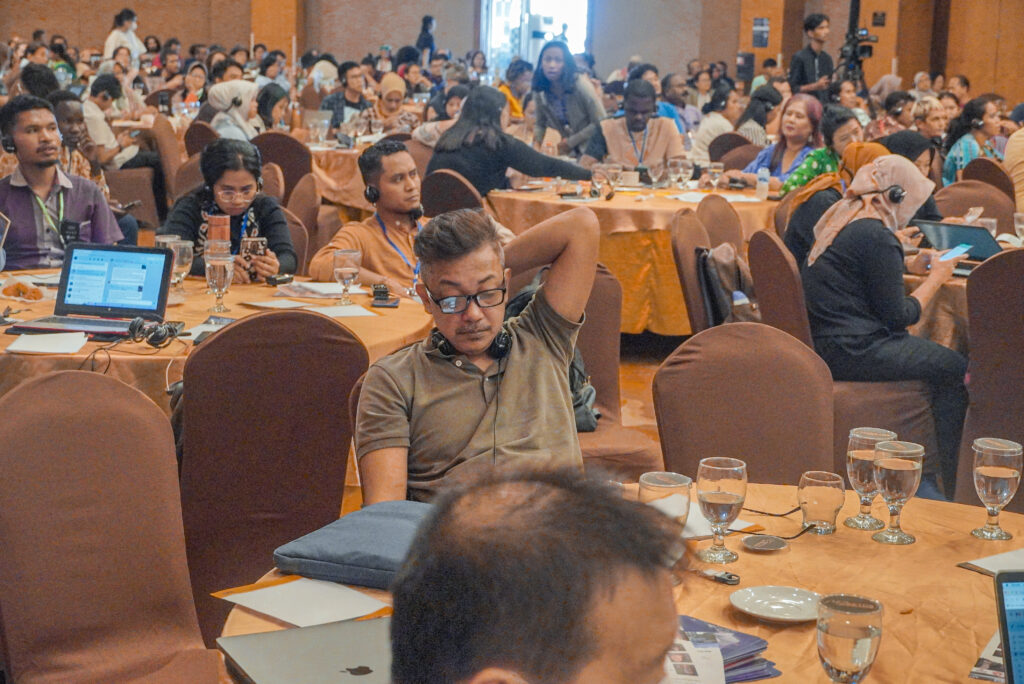
CNRG Executive Director Farai Maguwu and CNRG community organizer for Hwange Ms Thobekile Shoko are this week participating at the 2nd World Thematic Social Forum currently underway in Semarang, Central Java in Indonesia, courtesy of the People’s Dialogue – a South-South partnership of progressive civil society organizations and churches resisting extractivism.
CNRG is a member of the People’s Dialogue. The Forum heard testimonies from community representatives drawn from around the world on how extractive industries impact their lives. Extractivism encompasses mining, large-scale commercial agriculture, fishing and timber harvesting. Activists from the seven continents of the world shared stories of people’s struggles against extractivism. Coastal communities bemoan colonial-style laws and policies alienating them from fishing zones in preference to big companies.
The rush for critical minerals also came under intense discussion. Speaking during a panel discussion, Maguwu said critical minerals are yet another wave of destructive mining repackaged as an opportunity. He said the mode of production and international division of labor which tasked developing countries with the production and export of raw minerals hasn’t changed.
“China, which mines only 13% of the world’s lithium, now controls 70% of global lithium production and has over 50% of the world’s lithium processing capacity. There is no indication, whatsoever, that China intends to enhance the capacity of producer countries to migrate from the primary value chain level of Industrial lithium raw materials to the secondary value chain level of battery technology production. Thus lithium, known also as the white gold, is following the way of all minerals in terms of adding to the resource curse syndrome in producer countries where abundance of natural resources does not translate to wealth for the citizens of those countries” added Maguwu
There is a growing narrative among NGOs claiming critical minerals are an opportunity. We ask again: an opportunity for who? When Zimbabweans in rural areas, Mberengwa in particular, discovered and artisanally mined lithium at Sandawana, for a while they benefited, and lives were transformed. A tonne of lithium ore was sold for $120. This was abruptly stopped by the government. And yet, involving locals at the primary source of the value chain would have gone a long way in reducing rural poverty and inequality as well as creating livelihoods in rural areas.
Through participation and deriving direct benefits from lithium, this would have seen the community embracing the ‘Critical Minerals’ narrative. This is not the case. They were dispossessed and alienated from a resource at their doorstep. Is this new? Absolutely not. The same has happened in the diamond and gold sectors. It’s an internal logic within Zimbabwe’s statecraft that poor citizens must never be allowed to benefit from their resources. Consequently, there is collective anger and a feeling of being robbed by the State in Mberengwa, Goromonzi and Bikita. Thus, the criticality of lithium is felt by the ruling elites and those on the other end of the value chain. There is also no reinvestment of the lithium wealth in the community.
At the same event, Ms Thobekile Shoko spoke of how mining is destroying ecosystems, thereby weakening the ability of nature to sustain life. She said in Hwange where she lives, coal seam fires are burning humans, wildlife and forests. She said merely taking a walk is now a dangerous episode that can easily turn fatal in Hwange. Several children now have deformed limbs after the ground opened up and sucked them into burning coal seam fires. CNRG has documented the horrific stories of survivors.
At the Zimbabwe Mining Indaba, a local Chief from Bikita bemoaned the lack of development in his area despite scores of haulage trucks departing daily for Beira loaded with lithium. The story rings true throughout the continent. Mining is undermining human development through exclusion, violence and destruction of ecosystems which sustain life. The direct and structural violence that accompanies extractivism exhibits the features of colonialism and much more.