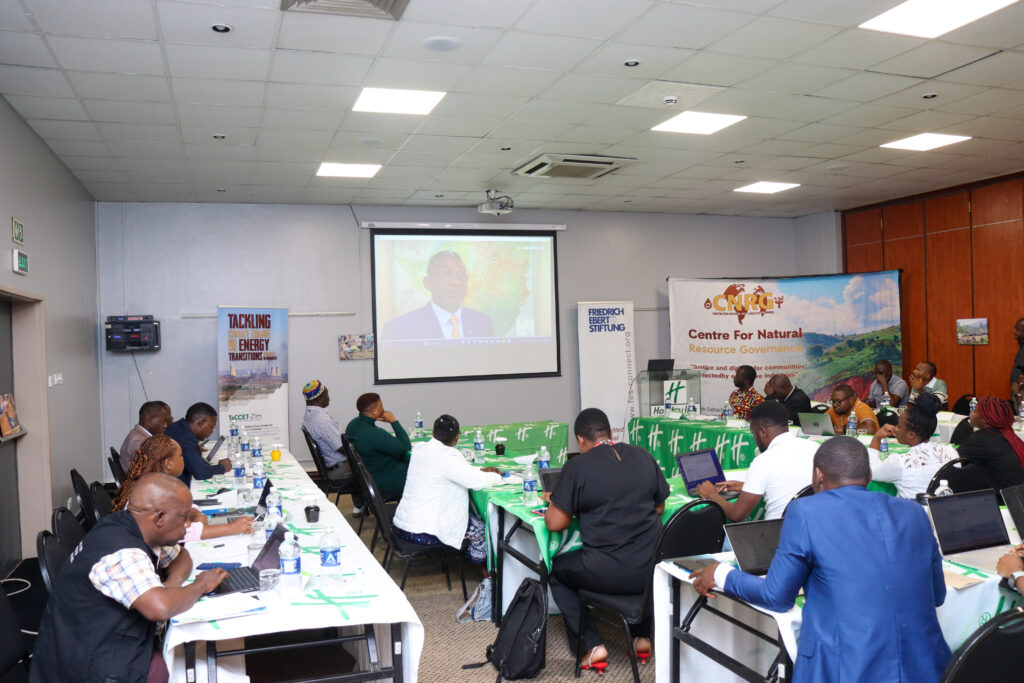
The Centre for Natural Resource Governance (CNRG) and the Friedrich Ebert Stiftung on Wednesday teamed up for an Extractive Industries and Just Transition side session during the 12th Edition of the Zimbabwe Alternative Mining Indaba (ZAMI) where the two organisations took turns to reiterate on the need for communities to benefit from natural resources extracted in their areas.
This year’s Indaba ran under the theme “A Just Energy Transition: Unlocking Community Potential and Participation” and took place from the 16th to the 20th of October 2023 in Bulawayo.
The side session was aimed at advancing economic and social policies in Zimbabwe that centre on climate and gender equity.
While presenting on the topic “Transitional Minerals: Challenges and Opportunities,” CNRG Programs Manager George Nyamaropa called upon African countries mostly Zimbabwe, to be agile in the rush for critical minerals so that they put in place mechanisms to allow communities to benefit from the extraction of minerals in their communities.
“Africa needs to strike a balance between the need to safeguard local communities’ rights and the environment when extracting critical minerals in order to ensure climate justice and combat climate change,” said Nyamaropa, adding:
“Africa is rich in critical minerals, with over 30% of global reserves of minerals such as cobalt, copper, and platinum group metals. The continent also has vast reserves of nickel, manganese, and rare earth elements. These minerals are considered vital for the transition to clean energy and reducing carbon emissions. However, the extraction of these minerals has been associated with negative social and environmental impacts in many African countries.”
CNRG has over the years raised concerns that local communities are usually left behind when it comes to benefiting from natural resource extraction in their areas, yet they are the ones who must see their lives developing from the vast mineral wealth around them.
The majority of communities in areas like Marange where diamonds were discovered still have nothing to show for the million-dollar exploration of natural resources. Some community members there were displaced and relocated to Arda Transau where there are undesirable living conditions.
Environmental degradation has also been a major worry, with evidence of soil contamination, water pollution, and deforestation caused by mining activities in several parts of the country like Mutare, Penhalonga, Hwange and Mvuma, conspicuous.
Nyamaropa stressed that one approach to solve the problem is to prioritize value addition and beneficiation of the natural resources extracted in these areas which would involve processing these minerals locally, creating jobs and increasing revenue to fund sustainable development.
“Local communities could benefit from these programs, leading to improved living conditions, access to clean energy, and reduced greenhouse gas emissions,” he said.
Hopewell Gumbo, the FES Programmes Coordinator, also spoke during the side session in Bulawayo about these injustices and emphasised the need for a tighter relationship between Climate Change, Just Transition, and the involvement of host communities in the mining areas.
“We can’t talk about a Just Transition without mentioning greenhouse gas reduction. As we green the economy, let us ensure that no one is left behind. One approach is to prioritize value addition and beneficiation, which would involve processing these minerals locally, creating jobs and increasing revenue to fund sustainable development,” said Gumbo.