By Lameck Makula
The Centre for Natural Resource Governance (CNRG), in collaboration with the Centre for Research for Peace and Development in Africa (CRPDA), have intensified efforts to advocate for mining revenue decentralisation.
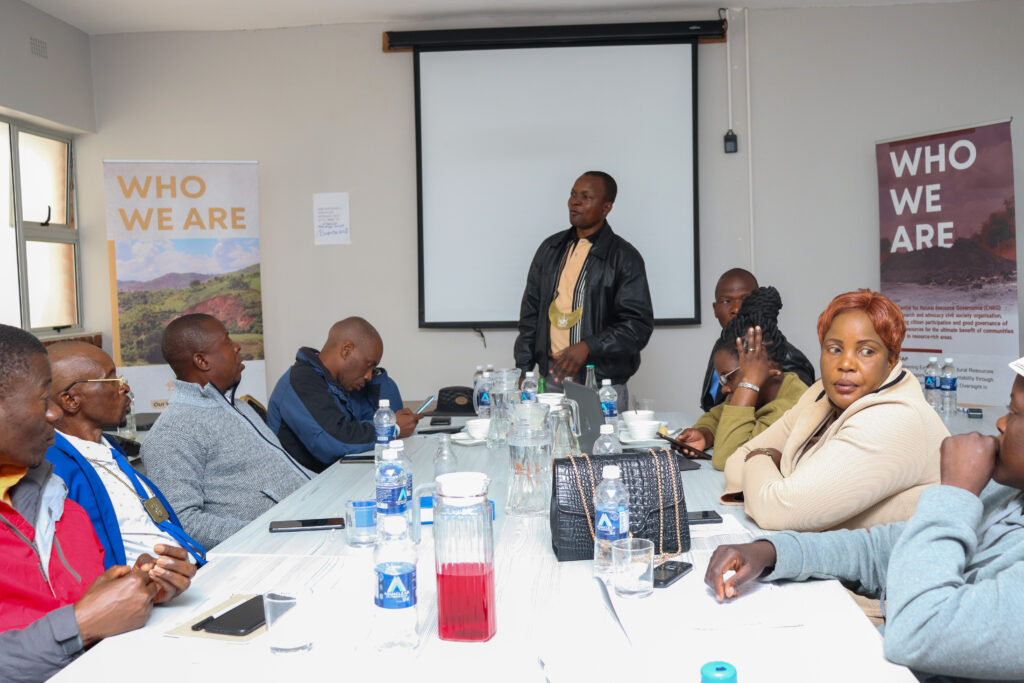
The two organisations recently hosted mining community representatives from Community-Based Organisations, community members, Rural District Councils (RDC’s) and chiefs for a multi-stakeholder dialogue to discuss revenue collection and taxation in relation to the extractive sector management.
The meeting was held on August 1, 2023, in Mutare.
The goal of the dialogue was to provide a foundation for future involvement with policymakers in advocacy for decentralized, accountable, and transparent tax collection from the mining sector.
CNRG has been working to strengthen and empower civil society, mining-affected communities and citizens to effectively hold duty bearers, state actors, and the executive accountable through the USAID-supported Strengthening Extractive and Natural Resources Sector Transparency and Accountability through Citizen Action and Parliamentary Oversight in Zimbabwe (STACAP) project. Through this activity, we advocate for the devolution of natural resource governance to ensure local authorities have adequate resources to deliver social services to local communities.
This was after it was discovered that most of Zimbabwe’s mining communities have nothing to show for the minerals extracted from their surroundings.
Speaking during the discussion, Chief James Mutasa called on mining companies to meaningfully contribute to the upliftment of the local communities.
“In most mining villages, the relationship between mining and development is disappointing. The problem is that current mine owners merely come to mine and then leave, leaving communities with massive problems that they are expected to address on their own. Our call is for mining investment to help develop improved public service delivery and infrastructure,” he said.
CNRG has been advocating for transparency and accountability in the mining sector for over a decade. The calls were prompted by the observation that, despite being hyped as the solution for Zimbabwe’s economic revival, mining was actually contributing to weak governance, declining service delivery, and organized crime.
CNRG Programs Manager George Nyamaropa also urged for local beneficiation and mining development to contribute to the welfare and good service delivery within mining communities during the same conference.
“Communities’ ability to develop sustainable livelihoods is harmed where mining is active. It is for this reason that communities must be involved in benefit sharing and dialogues prior to, through, and after mine closure.”
“Mining in Zimbabwe remains an enclave economy detached from people’s aspirations; there is a wave of dissatisfaction and rejection of the current mining system, with environmental degradation being the sole visible impact on communities. As a result, resource extraction should contribute to considerable changes in the communities where mining occurs”, said Nyamaropa.
The multi-stakeholder engagement in Mutare was aimed to improve the effectiveness and efficiency of stakeholder participation in the implementation of sustainable natural resource management, as well as to empower local governments to diversify their revenue bases, particularly by obtaining a fair share from natural resource exploitation, for transparent and accountable public financial management and local budgeting, and to raise marginalized voices, including youth, women, artisanal and small-scale miners, and concerns.
The mining operations in several areas fall short of expectations as they lack the capacity to empower local communities.
On the other hand, the mining operations are not sustainably contributing to economic growth and largely better service delivery.
CNRG has therefore over the years noted that the country has a richness of natural resources that has failed to improve the lives of the commons.
Despite recent economic improvement, the country continues to be plagued by entrenched poverty and frighteningly high and rising inequality.
Growing poverty is evidence of rising disparities as a result of bad governance and management of natural resources.
With over 400,000 artisanal and small-scale miners, mining has become a key economic sector in Zimbabwe, owing largely to the collapse and slow recovery of the manufacturing and agricultural sectors, which previously contributed significantly to the national fiscus.
However, the sector remains unregulated, unrecognized, and vulnerable to corruption, human rights abuses, environmental crimes and injustice in mining host communities.
This has spurred corruption, poor contract negotiations, a lack of transparency and accountability in taxation, and Illicit financial flows through tax evasion.