
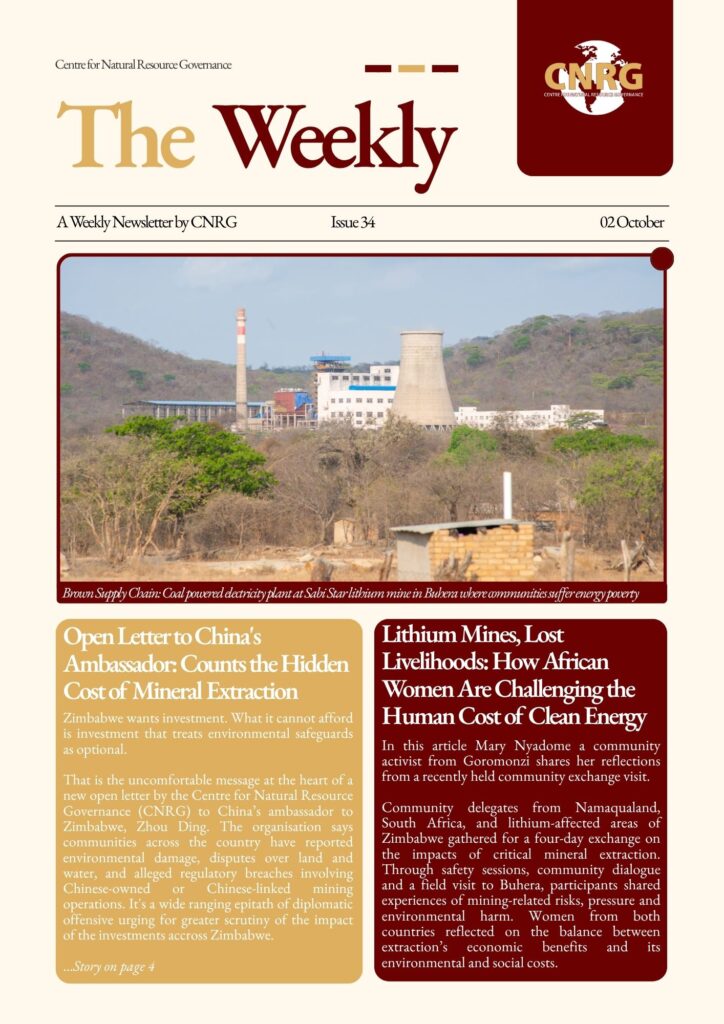
The Costs of Extraction, the Power of Communities
The 34th edition of The Weekly examines a question that is becoming increasingly difficult to ignore: what happens to communities when the global demand for minerals collides with the realities of life on the ground?
Across Zimbabwe and beyond, the energy transition is driving demand for critical minerals, while mining continues to promise jobs, investment, exports and economic growth. Yet behind these promises are communities living with polluted rivers, damaged landscapes, disrupted livelihoods, inadequate consultation and unanswered questions about who ultimately bears the cost of extraction.
At the centre of this edition are women from mining-affected communities in Zimbabwe and South Africa, whose experiences challenge the assumption that a transition to cleaner energy is automatically a just transition. Their exchange demonstrates that climate and energy policy cannot be separated from questions of water, land, biodiversity, livelihoods, human rights and participation. For women in particular, the consequences of mining are often felt through responsibilities for water, food production, household care and community wellbeing.
The edition also turns to the question of mining formalisation. At the Midlands State University ASM Summit, CNRG argued that formalisation must be more than issuing licences. It must bring community rights, environmental protection, access to finance, technical support, grievance mechanisms and meaningful participation into the mining relationship. Formalisation that excludes the people living alongside mining operations risks simply making an existing system more official without making it more accountable.
The health of Zimbabwe’s rivers provides another warning. From the Mazowe catchment to communities downstream of mining operations, concerns over sedimentation, pollution and water access raise fundamental questions about environmental regulation. The experience of a Glendale farmer whose irrigation infrastructure is reportedly being affected by sediment illustrates how environmental degradation can quickly become an agricultural and livelihood crisis.
Meanwhile, Christmas Pass has emerged as a powerful test of environmental governance and public accountability. The dispute is no longer confined to the question of whether mining should take place on Mutare’s mountain slopes. It now encompasses legal challenges, environmental approvals, community consultation and questions surrounding water and electricity infrastructure associated with the development. The competing claims surrounding the infrastructure underline the need for transparency and independent verification.
This edition also carries CNRG’s open letter to China’s Ambassador to Zimbabwe, placing the debate within the broader relationship between investment and accountability. The issue, as the letter and accompanying analysis make clear, should not be reduced to nationality. Chinese companies, Zimbabwean companies, regulators and political actors must all be subject to the same fundamental principle: investment must operate within the law and must not transfer environmental and social costs to communities.
The stories in this edition therefore converge around one central idea: Zimbabwe’s natural resources cannot be discussed only in terms of what can be extracted. We must also ask what is being lost, who decides, who benefits and who pays.
A just and sustainable resource economy requires more than minerals leaving the ground. It requires clean water, protected ecosystems, decent livelihoods, meaningful participation, transparent institutions, responsible companies and communities with the power to shape decisions affecting their lives.