
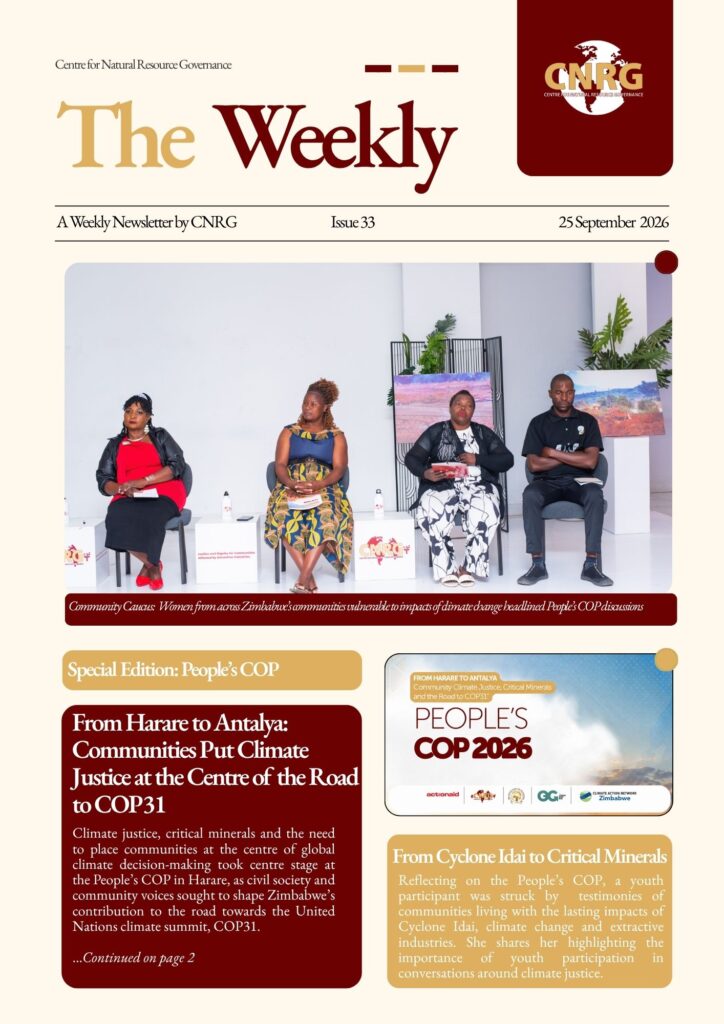
Communities at the Centre of Zimbabwe’s Resource and Climate Debate
The 33rd edition of The Weekly brings together stories, analysis and community voices from across Zimbabwe’s increasingly important debates on climate justice, critical minerals, mining, environmental protection and accountability.
At the heart of this edition is a simple but urgent question: who benefits from Zimbabwe’s natural resources, and who bears the costs of extracting them?
The edition leads with the People’s COP in Harare, held under the theme “From Harare to Antalya: Community Climate Justice, Critical Minerals and the Road to COP31.” The gathering brought together civil society, community representatives, activists and other stakeholders to connect Zimbabwe’s local climate realities with the global climate negotiations. It also placed a spotlight on the need for climate finance that is accessible, accountable and capable of delivering tangible benefits to communities.
The edition amplifies the voices of communities living with the consequences of climate-related disasters. From the continuing struggles of Cyclone Idai survivors in Chimanimani and Chipinge to the experiences of communities affected by mining, the stories demonstrate that climate justice cannot be separated from questions of livelihoods, infrastructure, dignity and accountability.
The issue also turns to Zimbabwe’s growing role in the global critical minerals economy. As demand for minerals linked to the energy transition increases, communities are asking important questions about beneficiation, environmental protection, participation and equitable benefit-sharing. The message emerging from these conversations is clear: the energy transition must not reproduce the inequalities associated with previous models of extraction.
Closer to home, the renewed campaign to stop mining at Christmas Pass highlights the importance of sustained community advocacy. The campaign, which CNRG began in 2025, has moved from raising concerns about mining at the iconic Mutare landmark to demanding effective enforcement, environmental rehabilitation and accountability for damage already caused. The Christmas Pass story is ultimately about whether environmental safeguards and government orders can provide meaningful protection for communities.
The edition also takes readers to the Southern Africa People’s Summit, where community leaders and activists challenged existing approaches to critical minerals governance. Their experiences raise a fundamental question for the region: how can Africa participate in the global energy transition without communities once again paying the environmental and social price?
Meanwhile, Penhalonga’s latest mining tragedy brings the human cost of Zimbabwe’s gold economy sharply into focus. The reported deaths at Rezende Mine are examined against a longer history of fatalities in the district, raising questions about mine safety, accountability, tribute arrangements and the economic value placed on the lives of artisanal miners.
Taken together, the stories in this edition reflect CNRG’s commitment to putting people before profit and ensuring that communities are not reduced to spectators in decisions concerning their land, resources and futures.
Read the 33rd edition of The Weekly for community voices, frontline perspectives and critical analysis of Zimbabwe’s natural resource and climate governance landscape. Because the real measure of development is not simply what is extracted, but what communities gain, what is protected and who is held accountable.