
By Staff Reporter
Zimbabwe’s diamond marketing and valuation processes are often shrouded in secrecy, contributing significantly to illicit financial flows across the African continent. Experts and critics are emphasizing the need for transparency and accountability to ensure that the country reaps appropriate benefits from its diamond sector.
Despite being the seventh-largest producer of diamonds globally Zimbabwe faces a troubling reality, the increase in diamond production does not correlate with a rise in income. Currently, production stands at 4.91 million carats but these volumes are projected to decline between 2024 and 2027.
The country earned US$303 million analysts state that if Zimbabwe embraces diamond value addition and beneficiation, the country could potentially earn over US$8 billion annually and create around 200,000 jobs.
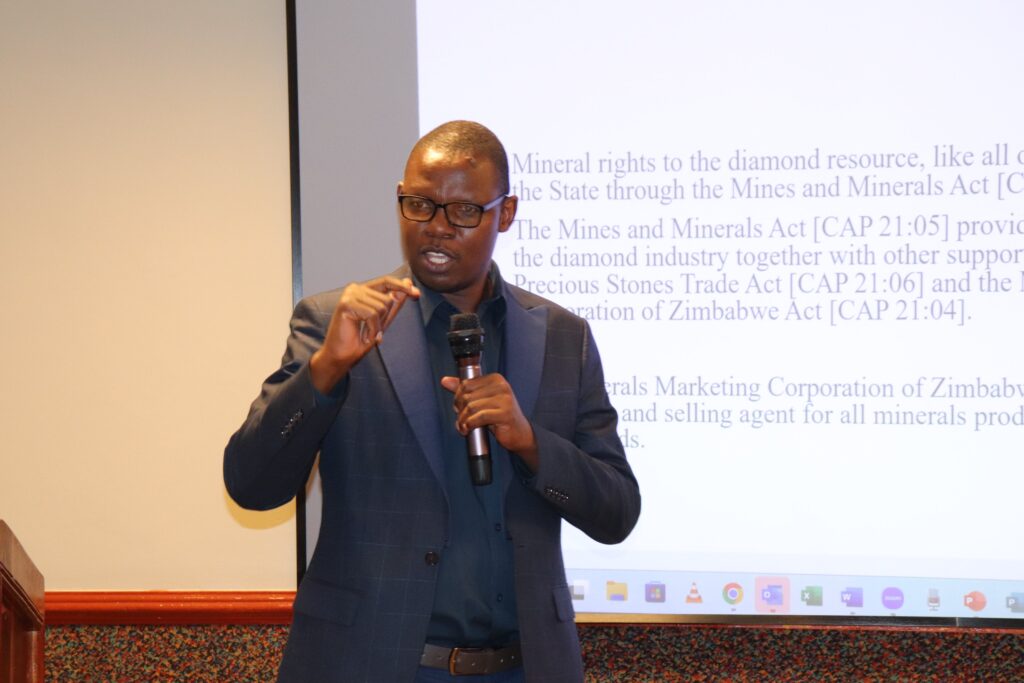
Recently the Centre for Natural Resource Governance (CNRG) hosted a breakfast meeting aimed at fostering collaboration among various stakeholders for a more transparent and equitable diamond industry that benefits all Zimbabweans, especially those in diamond-producing communities.
Unfortunately, diamonds from Zimbabwe are often sold opaquely, primarily to buyers in the UAE, without competitive bidding or tender processes, further complicating the industry’s transparency landscape, stated CNRG executive director Farai Maguwu.
He says evidence suggests the presence of a deep state in unclear transactions, with discrepancies in reported figures and volumes. The Zimbabwean diamond value chain is plagued by politicians overriding technocrats, creating parallel structures that link to global networks.
Maguwu states that these networks include global diamond marketers which appoint conflicted state officials to their boards of directors, presenting a clear conflict of interest and this undermines the nation’s interests and betrays the trust of the Zimbabwean people.
“The sector operates like a cartel, allowing only a select few players access to its lucrative opportunities and our country is suffering from a natural resource curse.
“There is a deep state or informalisation of the state where there is a formal government that operates outside the confines of the law that is the elephant in the room that we need to address in Zimbabwe.
“We also have politicians overriding technocrats in the Zimbabwean diamond value chain. Such parallel structures have a link to global networks, including global marketers of diamonds, which appoint conflicted state officials to their boards of directors. Such betrayal of the nation is unthinkable.”
Rangarirai Chikova from the Pan African Lawyers Union (PALU) a forum of lawyers and lawyers’ associations in Africa, highlighting the urgent need for reform states that this is a continental challenge as diamonds are responsible for over 12 percent of illicit financial flows.
He states that the lack of transparency and accountability in the murky but lucrative diamond sector is alarming, with many companies operating from tax havens and utilizing shell companies to obscure the identities of actual owners. Due to its high value and the ease with which diamonds can be smuggled across borders, the diamond sector is particularly vulnerable to illicit financial flows.
“Without political will, necessary reforms are likely to stall, perpetuating corruption and mismanagement of diamond revenues. This situation undermines national development, exacerbates inequality, and fosters public distrust in governance.
“Political will is essential for driving policy and legal reforms. To achieve this, it is crucial to build awareness, foster collaborations, and align political interests.
“Zimbabwe could benefit from joining the Extractive Industries Transparency Initiative (EITI) to promote global best practices in transparency and accountability. The ongoing efforts to establish the Zimbabwe Mining Revenue Transparency Initiative (ZMRTI), a domestic version of the EITI, should be prioritized.”
The Kimberley Process Certification Scheme (KPCS) must be strengthened to ensure that only conflict-free diamonds enter global markets, states Chikova. Established in 2003 by a United Nations General Assembly resolution, the KPCS aims to prevent ‘conflict diamonds’ from infiltrating the mainstream rough diamond market.
Current players in the Zimbabwean diamond industry include the Zimbabwe Consolidated Diamond Company (ZCDC), Anjin, and Murowa Diamonds, with the country also exploring partnerships with the Russian conglomerate Alrosa.
Alrosa plans to start production in 2024 in the Malipati site, a large concession that takes in part of the provinces of Matabeleland South and Masvingo.
ZCDC, a state-owned entity under the Ministry of Mines and Mining Development, has ceased to publicly disclose its annual reports. This lack of transparency is notable, particularly since the company had previously complied with the International Monetary Fund’s (IMF) Staff-Monitored Program (SMP) requirements.
In contrast, the Minerals Marketing Corporation of Zimbabwe (MMCZ) consistently publishes its audited annual reports, although the timeliness of these reports remains a concern. This disparity in transparency between ZCDC and MMCZ raises questions about the government’s commitment to accountability and openness in the mining sector.
Dr. James Tsabora points out that the tendering system has its downsides, including potential collusion and manipulation of pricing information.
“Information and data on the marketing and valuation of diamonds in Zimbabwe is very scarce and difficult to obtain. The current system that is used to market diamonds is also susceptible to manipulation,” he said.
The Zimbabwe Mining Development Corporation and MMCZ serve as the sole marketing and selling agents for all minerals produced in Zimbabwe, including diamonds. Marketing to the local market is governed by Statutory Instruments 157 of 2010 and SI 79 of 2014, which stipulate that a minimum of 10% of production must be set aside in a diamond pool for sale to local manufacturers.
These manufacturers are responsible for sorting, grading, evaluating, cutting, and polishing the stones before selling them in local or export markets.
The MMCZ evaluates diamond parcels separately and prepares them for tender after selecting customers from its database in agreement with the producers. This process reserves 10% of production to be allocated to local manufacturers for beneficiation and export.
Industry insiders have also revealed that the country could benefit more from the setting up of such value-addition bases as the quantum of high-value gems in Chiadzwa constitutes only a nominal percentage of diamond production.
Plans to establish a Gemology Centre in Mutare, aimed at polishing and cutting diamonds locally, have been stalled since 2020. Despite the Zimbabwe School of Mines (ZSM) being allocated land by the Mutare City Council for the construction of a state-of-the-art facility, the project has failed to progress.
The government allocated $30.5 million to the project in 2020, but the construction of the center in the Fernhill Special Economic Zone was delayed due to the COVID-19 pandemic and other logistical challenges.