
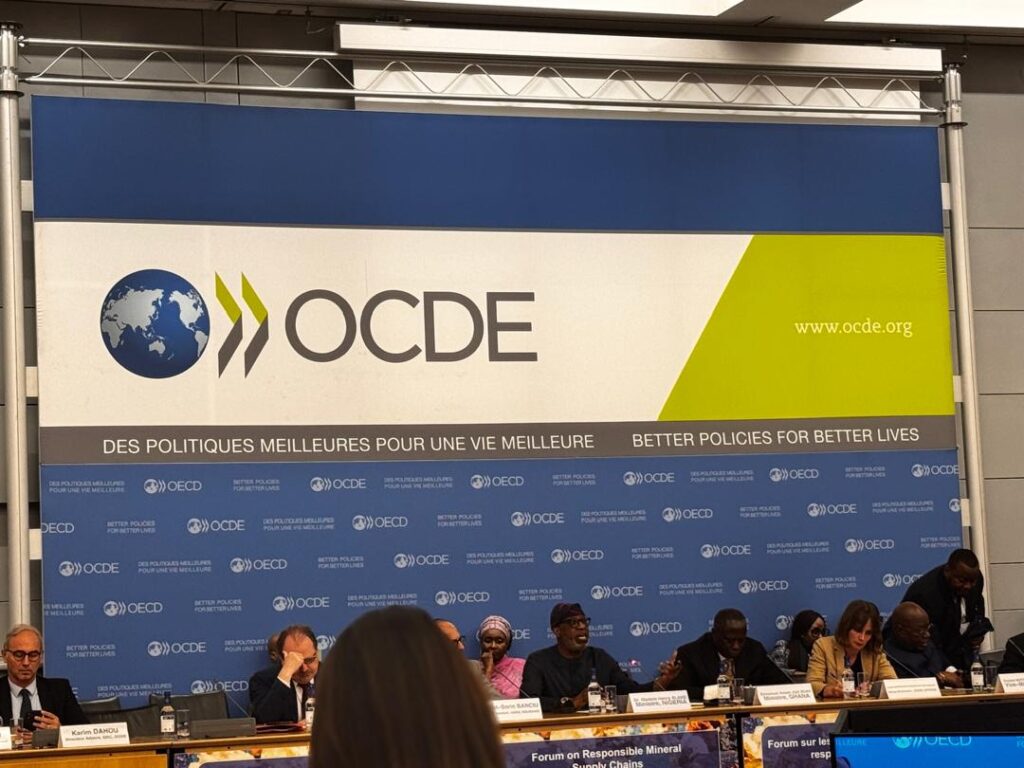
At the OECD Forum, Zimbabwean civil society calls for a shift from extractivism to accountability in the mining sector.
By Donald Nyarota
Delegates convened at the Organization for Economic Cooperation and Development (OECD) Forum on Responsible Mineral Supply Chains to discuss enhancing transparency, traceability, and due diligence in global mineral markets. Among the voices urging reform was Farai Maguwu, executive director of Centre for Natural Resource Governance (CNRG), who presented a critical analysis of Chinese investments in Zimbabwe’s extractive sector.
OECD is an international organization of 38 countries committed to democracy and market economies, serving as a forum where governments collaborate to develop economic and social policies and standards.
The OECD Forum, which ran from May 5 to 7, aimed to address pressing issues in mineral supply chains, including transparency, traceability, and the role of commodity traders in due diligence processes. Sessions explored the challenges of ensuring a reliable flow of information regarding the origin and movement of minerals and the credibility of due diligence claims.
A Pattern of Neglect
Maguwu’s assessment highlights a troubling pattern: Chinese mining operations in Zimbabwe often proceed with minimal regard for environmental standards, community consultation, and governance protocols.
Despite legal frameworks such as Section 73 of Zimbabwe’s Constitution and Section 97 of the Environmental Management Act, which mandate Free, Prior, Informed, and Consent (FPIC), these provisions are often ignored.
Consultations, when conducted, are often superficial or fraudulent, paving the way for violations of cultural, land, and labor rights.
Communities Bear the Brunt
The repercussions for local communities are severe. Environmental degradation, displacement, and erosion of cultural heritage have fostered deep-seated mistrust toward both foreign investors and the Zimbabwean government.
This mistrust is compounded by the perception that the government prioritizes foreign investment over the welfare of its citizens.
In areas like Marange, Manhize, Mutare, and Buhera, communities have reported displacement, pollution, lack of legal compliance, and unfulfilled promises of development. For instance, in Mutare, a Chinese company commenced quarrying activities without conducting the required environmental impact assessments, leading to public outcry and legal challenges.
A Call for Structural Change
Maguwu advocates for a fundamental shift in Zimbabwe’s approach to mining. He calls for transitioning from an extractivist economy focused on raw mineral exports to one that develops local value chains, thereby fostering sustainable economic growth. Additionally, he urges the Zimbabwean government to establish clear policies outlining expectations and compliance benchmarks for foreign investors, particularly Chinese firms.
Zimbabwe’s Ministry of Justice, Legal and Parliamentary Affairs has expressed interest in developing a National Action Plan (NAP) to ensure companies, especially in mining, uphold human rights standards, providing a framework for state protection, business respect, and remedies for violations.
This is in response to pressure from civic society players like CNRG and with civic the Zimbabwe Environmental Law Association (ZELA), among others, that government priorities include community engagement, environmental protection, and labor rights. Focus will also be placed on ensuring meaningful consultation and accountability in corporate operations.
The initiative sounds promising, but without concrete action, its goal of promoting responsible business conduct and economic equality remains doubtful.
Global Implications
Maguwu’s critique resonates beyond Zimbabwe, prompting a broader examination of Chinese mining practices in Africa compared to other regions. He questions whether Chinese companies operate with the same standards in Europe and North America as they do in Africa.
If discrepancies exist, he argued, African nations must introspect and demand equitable treatment.
“Comparative studies aimed at comparing Chinese companies in Europe, North America, and Latin America to those operating in Africa are needed. Are Chinese companies in Europe performing the same way they do in Africa? If the answer is no, then Africa must introspect.
“Zimbabwe needs a clear policy for engaging China – this policy must outline government expectations and benchmarks for compliance,” says Maguwu.
The Forum’s Broader Agenda
The OECD Forum addressed these concerns by focusing on supply chain transparency, traceability, and the role of commodity traders in minerals due diligence. Sessions also explored environmental due diligence and initiatives to formalize artisanal and small-scale mining.
These discussions aimed to foster responsible business conduct and ensure that mineral wealth contributes to sustainable development.
A common denominator of the discussions at the Forum was the OECD Due Diligence Guidance for Responsible Supply Chains of Minerals from Conflict-Affected and High-Risk Areas (OECD Guidance). The OECD Guidance establishes a common understanding of due diligence in the sector to help companies meet expectations on due diligence laid out in the OECD Guidelines for Multinational Enterprises.
As the forum progressed, voices like Maguwu’s underscored the urgent need for systemic change in the global extractive industry. Ensuring that mineral wealth benefits local communities and upholds human rights requires not only robust legal frameworks but also the political will to enforce them.