
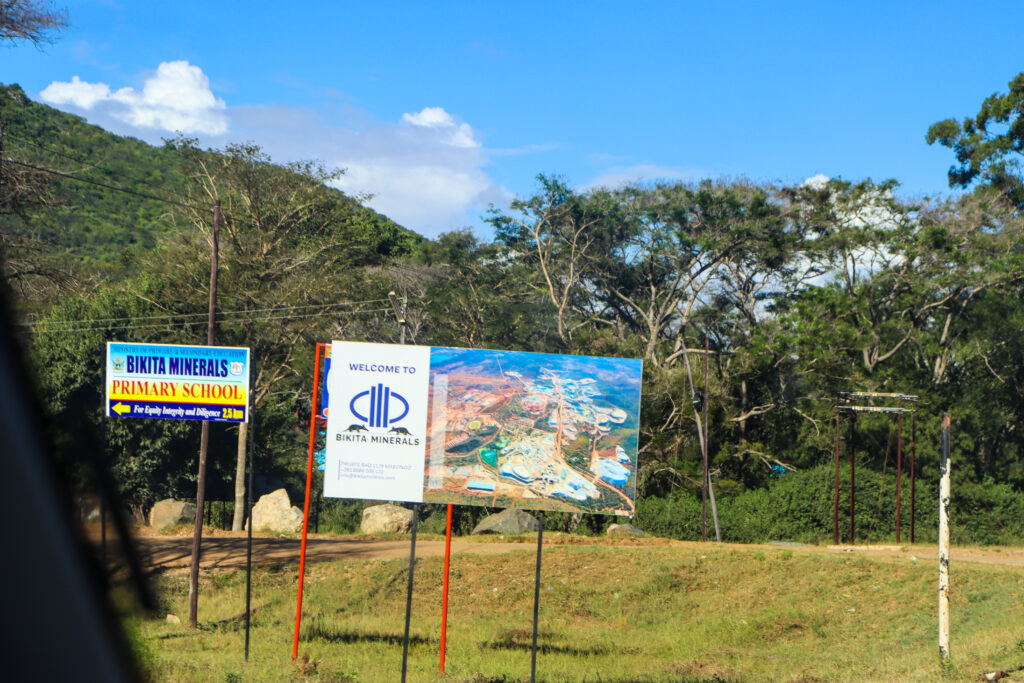
Prioritization of a Lithium miner and a private school over communities makes it harder to adapt to climate change in Bikita, Masvingo Province, as water scarcity exacerbates the El Nino crisis.
By Staff Reporter
Water rationing by the local water authority the Zimbabwe National Water Authority (ZINWA) is brewing conflict with communal farmers along the Mungezi River Ranch, Masvingo Province, the Weekly has established.
Communities along the Mungezi Range conflict with a lithium miner, Bikita Minerals and Riverton Academy a private college is over access rights to water from Matezva Dam. ZINWA prioritizes the miner and a private school, leaving downstream communities without water for agriculture and livestock.
This infuriates locals in a nearby irrigation scheme as well as hundreds of families who should access water when it is allocated equitably. Yet the sway of corporate muscle has left the locals in limbo at a time when El Nino-induced drought has already worsened the situation.
Due to this biting drought, exacerbated by this allocation crisis, communities downstream are going without water for their livestock and agriculture, and “there will be a big social problem,” says a local community member.
The agricultural activities of villagers in wards 11, 12, and 30 in Bikita West, and those in neighboring Bikita East, Masvingo North, and Gutu South have thus been affected.
Villagers claim this has affected their livelihoods, and local leaders are calling for an equitable water allocation policy. Bikita Institute of Land and Development (BILAD) Chairperson Mountain Mujakachi said the failure to release water to downstream communities was unacceptable.
“We appeal for an equitable water allocation policy so that the resource can be distributed fairly to Mungezi communities, Riverton Academy, and Bikita Minerals. In particular, the two institutions must limit the amount of water they draw from the dam considering the drought. It is the communities that are most vulnerable,” said Mujakachi.
On its part, Zinwa says they are managing the dam to avoid draining it before the next rainy season, but communities argue they have enough water to meet everyone’s needs.
Residents have paid for water release, and a Memorandum of Agreement (MOU) has been signed with ZINWA, which has since started releasing water to downstream communities following an uproar.
Climate Change and development consideration
Sydney Chisi who grew up in the area bordering Bikita and Gutu, on a family farm purchased in 1952 in the Mungezi Purchase Area, says the issue of water scarcity was not a problem until the dam was constructed.
He reminisces of the 1992 drought in which the farmers and the community survived using the water from the Mungezi River.
“That river never used to dry up even after there was a resettlement project upstream by the government in the mid-80s. Yes, our cattle struggled during the 1991-92 drought but the river supported farmers from inner land.
“Then the Matezva dam project was put upstream close to Mungezi Ranch. The water seized to be ours. The flow became erratic. ZINWA took over the water and controlled how it was distributed. The reservoir must feed the Bikita mine and no consideration for those downstream.
“Now the peasant farmers must pull together about US$400 to have the water released by ZINWA. The entity forgets the critical role played by the farmers towards food security in Zimbabwe preferring a Lithium mine whose benefits have not served the Bikita majority,” says Chisi.
With the current climate-induced drought, farmers and their herds are left stranded and each day they count losses as ZINWA remains adamant on an unjust policy.
World Resources Institute (WRI), a think-tank, says climate change has aggravated the problem of water scarcity. Already, roughly half of humanity lives under what the WRI calls “highly water-stressed conditions” for at least one month a year.
The Southern African Development Community (SADC) – a grouping of countries in the region – appealed for $5.5bn (£4bn) in aid to combat the effects of drought in May. So far, only a tiny fraction has been received.
UN World Food Programme WFP has only received one-fifth of the $400m it needs for emergency assistance, he says, adding that southern Africa is experiencing its largest deficit in maize in 15 years.
“If you go anywhere in Southern Africa, family granaries are empty, and maize, which is the region’s most consumed in terms of carbohydrates, is now priced out of many people’s hands,” Tomson Phiri, southern African spokesperson for the UN World Food Programme (WFP).
“The situation is only going to get worse.”
One of the worst droughts in living memory is sweeping across southern Africa, leaving close to 70 million people without enough food and water. And the hunger and water crisis is yet to peak – October, the hottest and driest month of the year, is still to come.
“The call for climate justice is to ensure vulnerable communities especially women are treated fairly by their local authorities and institutions.
“Mungezi farming community could be one of the many examples dotted around the country and one wonders what motivates ZINWA to be so insensitive,” says Chisi, executive director of Reyna Trust is a climate justice organization that works to educate and empower climate activists and communities in Zimbabwe.
An overview of the lithium value chain use of water
The Bikita Minerals mine is the largest lithium mine in Zimbabwe. The privately owned company holds the world’s largest-known deposit of lithium at approximately 11 million tonnes.
It is the world’s foremost supplier of the lithium mineral Petalite owned by Chinese company Sinomine Resource Group which acquired Bikita Minerals, previously controlled by African Minerals Ltd, for US$ 180 million in January 2022.
Bikita Minerals’ lithium processing value chain from extraction, crushing, grinding, and flotation up to wastewater treatment requires significant amounts of water.
- Extraction: Lithium is often extracted from hard rock deposits or brine resources, which requires water to drill, blast, and transport the ore.
- Crushing and grinding: Lithium ore needs to be crushed and ground into a fine powder, a process that requires water to reduce dust and facilitate separation.
- Flotation: Lithium minerals are separated from waste rock using flotation, a process that involves mixing the powdered ore with water and chemicals.
- Chemical treatment: Lithium is then chemically treated to convert it into a usable form, such as lithium carbonate or lithium hydroxide, which requires water as a solvent.
- Washing and rinsing: The resulting lithium product needs to be washed and rinsed to remove impurities, requiring additional water.
- Cooling: Some lithium processing stages, like electrolysis, require cooling systems that use water to regulate temperature.
- Wastewater treatment: Finally, lithium processing generates wastewater that must be treated before disposal, which also requires water.
The water-intensive nature of lithium processing has raised concerns about its environmental impact, particularly in water-scarce regions like the Bikita district. As demand for lithium grows, finding ways to reduce water usage and improve efficiency in processing becomes increasingly important.
The call for the Mungezi farming community is an echo for climate justice, emphasizing the need to balance sustainability with development and the fair treatment of vulnerable communities in resource rich areas.