
By Tracy Mutowekuziva
The effects of the contentious land redistribution scheme launched by the Zimbabwean government in the early 2000s are still being felt today. The scheme entailed taking land from white commercial farmers ostensibly for redistribution to landless black Zimbabweans.
According to the Zimbabwe government the land resettlement program aimed at addressing historical land imbalances and fostering social and economic justice. The program’s proponents argue that it produced a number of benefits as redistribution of land was vital in reducing poverty as it gave the poor access to land for farming. By growing and selling agricultural products, this enhanced livelihoods and increased household income generation.
While relocated families in Manhize, Chivhu, benefited from this scheme and have been practising subsistence farming for nearly 20 years, they are now facing forced evictions.
Disregard of land rights
Most farmers had constructed structures, made the farms their permanent places of residence, constructed chicken fowls, pig fowls, cattle kraals etc. Some had drilled wells for their farm activities. However, this changed in 2022 when Dinson Iron and Steel, a Chinese mining company started extracting iron ore along the Manhize range of mountains.
The farmers had developed an inherent attachment to the land. They had adopted Manhize as their motherland since 2000. The customary law protects the right to land. Whilst the families are not opposed to being relocated, they are very concerned with the lack of compensation, poor housing units and lack of social amenities in the relocation area.
Violation of provisions of the law
According to the Mines and Minerals Act, the dominium in, and the right of searching and mining for, and disposing of all minerals, mineral oils, and natural gases, notwithstanding the dominium or right which any person may possess in and to the soil on or under which such minerals, mineral oils and natural gases are found or situated, is vested in the President. While the Act does not specifically address displacement of communities, it does make provisions that can lead to the relocation of communities in certain circumstances.
The Act allows the government, with the approval of the Minister responsible for mines, to acquire land for mining purposes. In cases where mining activities require the use of land occupied by communities, the government may acquire that land, which can potentially result in the displacement of those communities.
The Act also stipulates that where land is acquired for mining purposes, including the displacement of communities, adequate compensation must be provided for the loss of rights and interests in the land. The Act requires compensation to be fair and based on the market value of the land and any improvements made by the affected communities.
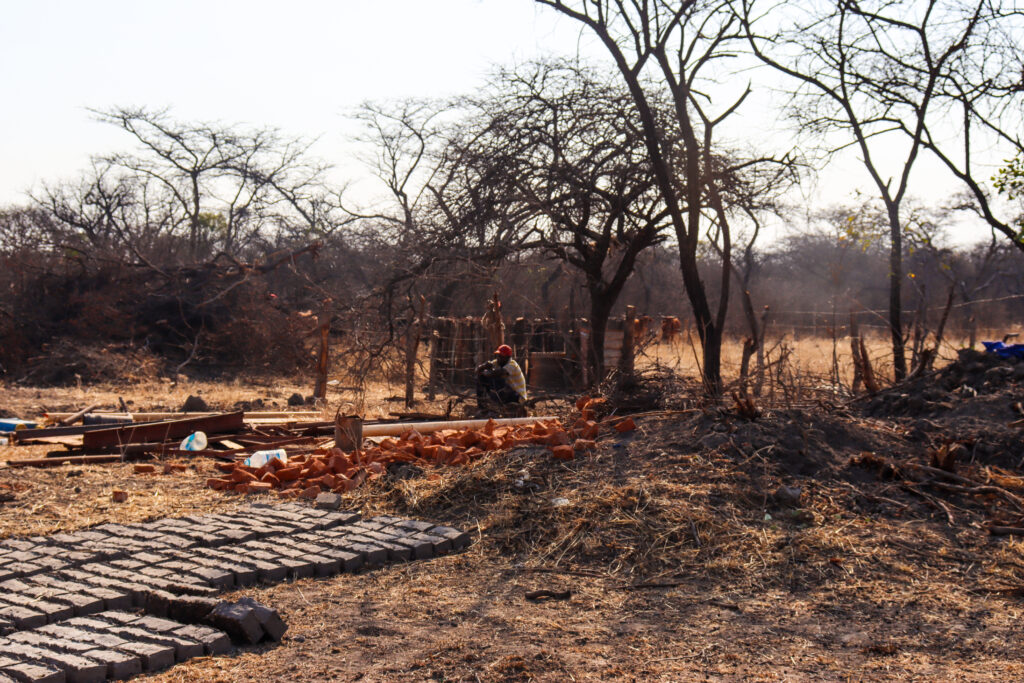
Instead, the company has built 3 roomed houses and a rondavel for each displaced farmer.
Relocated houses fall apart.
In December 2022, the farmers moved into the houses provided to them as alternatives, but they are already disintegrating due to poor workmanship and low-cost materials. The houses are cracking, substandard, and were built in just two days. The roofs of the rondavels have a vast gap, and in some cases, monkeys crawl into the houses and eat food supplies.
There has been no compensation for livelihood activities such as animal husbandry, and apiculture, despite the fact that these constitute the backbone of the farmers’ livelihoods. Families were given 27-hectare plots each, which is great, but the land needs to be cleared, trees chopped, and soil tilled, all of which require financial resources that have not been forthcoming from Dinson through the local government. The relocation area also seems to be arid and with poor agricultural soils.
Section 133 of the Mines and Minerals Act stipulates that any owner or occupier of the reserved ground who is injuriously affected by any mining operations carried on any underground extension block shall be entitled to recover compensation from the holder of such block in such amount as may be agreed or, failing agreement, as shall be determined by the Administrative Court. This has not happened in the Singlethorn area of Chivhu. In fact the company and the government are backtracking on the issue of compensation, citing that the houses built are adequate. The costs of setting up a new farm are not being considered.