
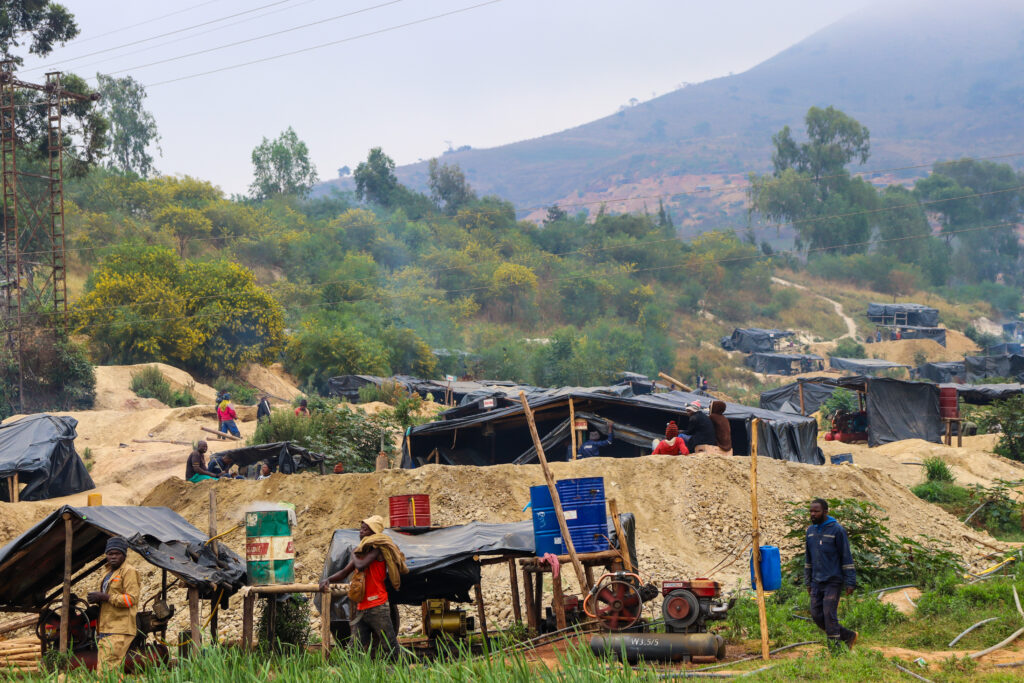
The Ministry of Mines and Minerals Development directorate in Manicaland has pledged to investigate and deregister peggers accused of underhand double allocation of claims by small-scale gold miners, the WEEKLY can reveal.
In response to oral submissions made by the Manicaland Miners Association chair Lovemore Kasha at a Multistakeholder Conference on Mining, Dr E. Savieri deputy (Provincial Mining Director) PMD called for miners to report such errant consultants to the ministry.
The Multistakeholder Conference was jointly organized by the Centre for Natural Resource Governance (CNRG) and the Peacebuilding and Capacity Development Foundation (PACDEF) in the backdrop of rising conflicts in the mining sector due to land use interests among stakeholders.
Dr Savieri said this was part of a drive to bring sanity to the sector as the ministry remains committed to understanding and resolving challenges faced by registered small-scale operators to improve productivity in the gold sector.
She said low productivity due to dangerous mine workings has militated against the government’s target to ramp up production across the mineral sector value chain in the province.
“We are appealing to miners to come forward and make reports of unscrupulous peggers that are making double allocations, because as you are aware they are not part of the ministry but registered consultants.
“Our directorate is seized with the matter, and we will investigate any reports with the view of deregistering peggers that are found operating outside their conditions of service,” she said.
In 2023 Manicaland province produced over 170kg of gold revealed Dr Savieri, while lithium totalled 40000 tonnes, diamond produce reached 1 million carats, 3500 tonnes of phosphate, and around 7000 tonnes of vermiculite.
However, such totals for gold were bellying the fact that many operators faced downtime over disputes, unsafe mine sites, and delays over dispute resolution by the provincial directorate said Kasha, chair of the provincial association of miners.
He said dispute resolution provisions that force immediate closure of mine sites when miners clash, while matters are under investigation have contributed to the depressed productivity in the gold sector.
“One main challenge we face as miners is that when there are disputes over double allocations of mining claims between miners the law states that the site is closed while the matter is being resolved.
“This has greatly affected production because the matters are taking too long to be resolved while there is no production on the ground. Further because of such delays when the operations resume the sites become dangerous and shafts collapse due to a long time of inactivity,” said Kasha.
CNRG executive director Farai Maguwu, said the communities are reeling under the devastation of the environment, water bodies, and underdevelopment of the local environs as externalized costs of mining.
He questioned why enforcement authorities including the Environment Management Agency (EMA) are failing to enforce the ban on alluvial gold mining along Odzi and Mutare Rivers which have been invaded by Chinese and artisanal miners.
“We have seen the perpetuation of mining without rehabilitation in Penhalonga and alluvial gold mining yet in 2020 cabinet passed a decision to ban alluvial mining but Mutare river is still being mined.
“We have the Odzi River also desecrated by Chinese mining along that river. We need to know what kind of support EMA needs from stakeholders to execute its mandate to enforce compliance with the mining regulations,” said Maguwu.
PACDEF board member Farirai Mudiwa said it was crucial to adopt responsible mining practices to enhance productivity in Manicaland, a province renowned for mineral endowment, but with challenges from the substantial presence of artisanal and small-scale miners.
“Social conflicts, environmental degradation, and mine accidents often with fatalities and dangers paused by unregulated mining practices are a challenge in the province. It is imperative to address challenges for mining activities to be more sustainable.
“We call on the government to expedite the cadastre system and focus on awareness raising over conflict issues on the legal frameworks in the mining sector through effective dissemination of information to local levels,” she said.
Dr Savieri said the ministry was engaged in a decentralization process underway to cater to the local needs of miners in districts and improve on the resolution of challenges faced by miners.
“The safe and sustainable mining we envisage as government is underpinned by a thrust of legislation for full compliance by mining companies and investors. Complimentary to this Ministry has been conducting awareness and training across artisanal and small-scale mines, joint operations with EMA to enforce responsible mining practices,” she said.
PACDEF is an organization working for peacebuilding and capacity development of communities in conflict. It was established in 2006, and works in Manicaland province, covering the three districts of Mutare, Mutasa, and Buhera.
The organization seeks to develop and disseminate strategies for alternatives to violence in response to conflict. It also addresses resource-based conflicts and has a desk for human rights and governance which deals with issues of local participation and human rights.