

The government’s hesitation and legislative loopholes threaten to turn a strategic resource into a squandered opportunity…
By Donald Nyarota
Beneath the dusty earth of Zimbabwe mineral mineral-rich districts of Bikita, Goromonzi, and Buhera lies a glint of promise, lithium, the mineral which is powering the global shift to electric vehicles and renewable energy. With Africa’s largest known reserves, Zimbabwe should be a lithium superpower- it also holds the fifth-largest global reserves. But instead of leading the charge in battery-grade processing and green industrialisation, the country remains trapped in a familiar pattern: exporting raw ore while importing disappointment.
The country maintains an extractivist model steeped in its colonial legacy, of mining for exports, which at its core is leading to natural capital depletion and driving inequality.
When Zimbabwe’s government announced a ban on the export of raw lithium in 2022, it offered a rare glimpse of policy boldness, applauded by sceptics and critics alike. It appeared it had set a clear goal to curb smuggling, retain value, and spark local beneficiation. However, nearly two years on, the ban exists more in principle than in practice. Export exemptions remain generous, enforcement is patchy, and value addition remains more a promise than a plan.
Trucks roll out of mines like Arcadia, Bikita, Prospect Lithium, and Sabi Star loaded with unprocessed ore, while Zimbabwe’s economy, badly in need of industrial lifelines, waits for the mineral miracle that keeps getting deferred.
Worse, a troubling clause in the proposed Mines and Minerals Bill threatens to strip lithium of its status as a strategic mineral altogether. In a move that has baffled economists and governance advocates alike, lithium does not appear in the Second Schedule of designated strategic minerals under the draft law. Instead, the bill grants discretionary powers to the Minister, subject to presidential approval, to designate strategic status through notice in the Gazette. This legislative ambiguity leaves one of Zimbabwe’s most promising assets exposed to short-term profiteering and opaque deal-making, rather than long-term national planning.
Designation of strategic minerals comes with conditionalities, inclusive of the requirement under Section 315 for investors in strategic minerals to enter Joint Ventures with the State. While this presents both an opportunity and a risk, it is a concrete action to draw value from minerals for the state’s broader benefit. JVs can be a powerful mechanism for ensuring national participation in the exploitation of critical resources, enhancing revenue retention, and fostering skills and technology transfer.
To enhance the potential of this provision, the law must clearly outline criteria for establishing JVs, including thresholds for equity participation, governance structures, and investment obligations. Additionally, there must also be safeguards in place to prevent corruption and elite capture, and to ensure that benefits are equitably shared with host communities. The government can come up with strategies like revenue-sharing agreements, local employment quotas, or community ownership models.
From Rocks to Raw Deals
Regionally in Africa, the so-called “critical minerals” boom has all but been a deja vu, reviving old habits. As Chinese-linked firms have moved swiftly to extract ore, exporting it to Asia for processing, while offering little in the way of downstream investment. In essence, Zimbabwe’s apparent willingness to quietly remove lithium from the strategic minerals list raises the spectre of elite capture- a resource being defined not by national need, but by private convenience.
This is not just poor economics. It is a violation of Zimbabwe’s Section 315 of the Constitution, which calls for transparency, value addition, and joint ventures that protect public interest. Failing to define lithium as strategic legally undermines every aspect of that constitutional commitment.
The Lost Time of Delay
The delay in fully implementing the raw export ban, announced initially in 2022 and revived in 2024 to apply in January 2027, has more than symbolic costs. Already offtake agreements were signed, logistics chains cemented, and investors locked into models that depend on exporting raw material. Each passing month has further entrenched a low-value mining model, where Zimbabwe earns crumbs for minerals that could power its own energy revolution. This is further worsened by the global commodity decline which is eroding value of the mineral touted as ‘white gold’.
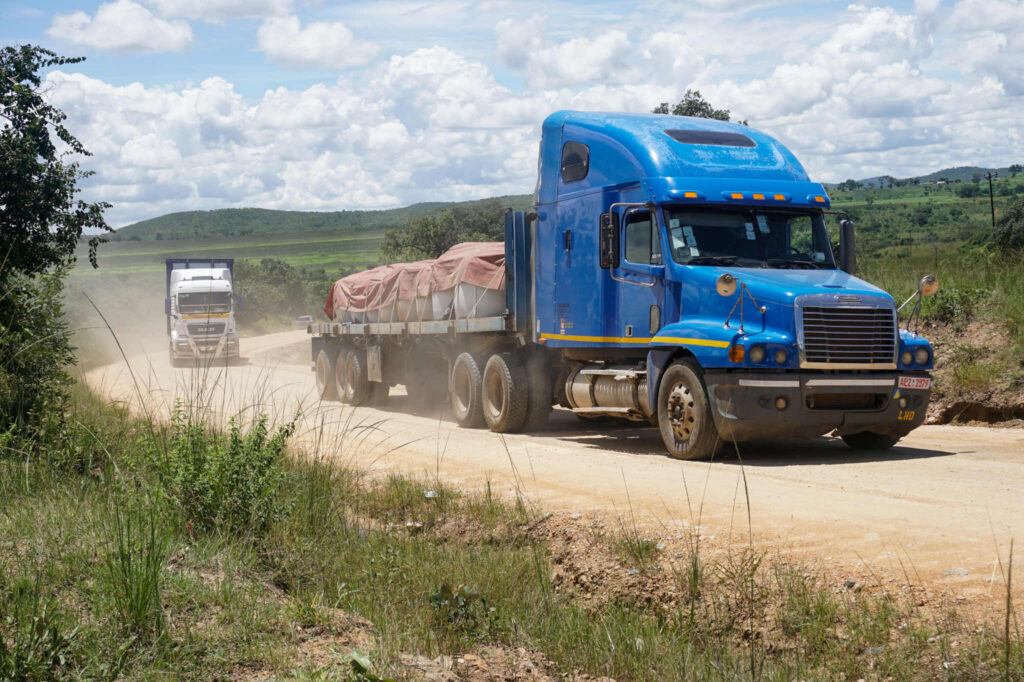
Trucks loaded with lithium in from Prospect Lithium, in Goromonzi district
In contrast, countries like Indonesia have successfully implemented export bans. By coupling restrictions with investment in infrastructure, skills, and local partnerships, they have turned raw materials into industrial springboards. Zimbabwe, meanwhile, is still debating whether lithium is worth protecting at all.
Law, Land and Lithium
The new Mines and Minerals Bill, now under review, does little to inspire confidence. In addition to the lithium omission, the bill sidesteps critical constitutional principles. It proposes that the Supreme Court, not the High Court, be the court of first instance in certain disputes, violating Section 169. It removes the right to appeal against prospecting refusals or ministerial decisions, clashing with Section 68 on administrative justice. Communities living on resource-rich land are denied meaningful consent, and landowners who withhold access risk being barred from mining for a decade—directly contradicting Section 71 on property rights.
These flaws are not incidental. They are symptoms of a deeper problem: the prioritisation of investor convenience over constitutional governance. An extension of the open for business mantra which ominously places broad based development at the periphery.
The Battery Age Won’t Wait
In the meantime, despite a decline in price, global demand for lithium is still expected to quadruple by 2030. The United States, European Union, and China are already scrambling to secure supplies. Zimbabwe has what the world wants—but whether it can retain and refine that value is another matter entirely.
If lithium is quietly removed from the list of strategic minerals, it won’t just be a legislative oversight. It will be a national betrayal. It will mean that Zimbabwe has learnt nothing from the Marange diamond fiasco, nothing from the ghosts of diamonds fields left unrehabilitated and unaccounted for.
To break this cycle, Zimbabwe must move swiftly:
- Codify lithium as a strategic mineral in law, not leave it to ministerial whim.
- Enforce the export ban with precision and transparency.
- Offer real incentives for battery-grade processing and beneficiation.
- And guarantee that local communities, those displaced (IDP) or living beside the mines, share meaningfully in the profits.
Zimbabwe stands at a crossroads between extractive repetition and transformational reform. Whether it rides the global battery boom or watches from the sidelines will depend not on the mineral beneath its feet, but the political will to govern it wisely.