
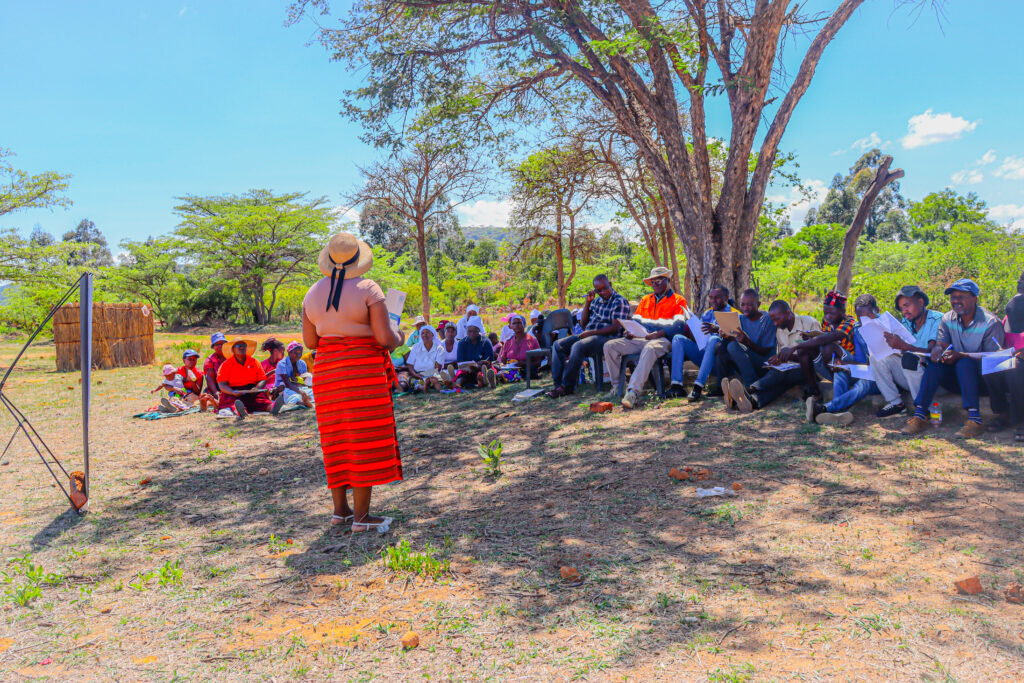
A workshop held on 10 November by the Centre for Natural Resource Governance in Manhize, Chivi to strengthen and empower civil society mining-affected communities and citizens to effectively hold duty bearers, state actors and the executive to account unearthed serious social, and human rights and environmental crisis in the area.
The training was in the form of an interactive workshop led by a facilitator from CNRG. The goal was to capacitate the community on issues that have to do with environmental laws, Human rights, and Free and Prior Informed Consent. The official narrative on Manhize is more on the expected economic benefits of the plant whilst silent on the externalized costs to be paid by the community. The Manhize community took the opportunity presented by the workshop to bring up various concerns they have about the project.
Tracey Mutowekuziva, the CNRG Deputy Programmes Manager summarised the pertinent issues bedevilling the community.
“Based on our engagement with the Manhize community, we have observed that the community is grappling with severe issues that can be categorized into three groups – social, human rights, and environmental. The main cause of these problems is the attitude of Dinson Mine towards the community which is disrespectful, insensitive, coercive and repressive. The Chinese owned company appear to enjoy the backing of powerful politicians in government,” she said.
The problems identified by CNRG team which visited the area include:
Social issues:
The community is neglected from making meaningful engagement and decision-making processes and the community members are being displaced without free and prior informed consent.
The Ministry of Housing condemned some of the houses that were built by Dinson mine for those who were displaced, those houses are substandard and as for now, they have cracks. This also resulted in unfair compensation of both the houses and land these people were allocated.
There are also reports of unequal job opportunities there are specific age groups recruited at that company which are 35 and below for other workers and 42 and below for drivers.
There are also reported cases of prostitution at Dinson Mine because the married male workers are isolated from their wives and this results in high rates of sexually transmitted diseases.
Human rights:
There have been issues of displacement affecting 6 plots in Manhize village, Ward 7.
It has been reported that Dinson failed to facilitate the signing of contracts for its workers. It is crucial to ensure that workers are afforded the opportunity to enter into contractual agreements that outline their rights, responsibilities, compensation, benefits, and working conditions. No committee advocates for the rights of workers.
There are also reported cases of poor working conditions. The workers are not allowed to take more than 1 day leave. At Dinson mine reports indicate that workers are earning low wages which is 150 paid in United States Dollars (USD) and the other 150 rtgs
Some of the community members have lost access to their burial sites to pave way for Dinson mining operations.
Since Manhize village is mainly dominated by agriculture, some of the farmers sell their products to Chinese companies but they are later paid in Zimbabwean dollars and with the current situation, it will have less value.
Environmental:
Dinson mine (Chinese-owned) is said to be disposing its sewage waste in Munyati River. The river serves as a crucial source of domestic water supply for the surrounding communities. However, the improper handling and disposal of sewage by Dinson mine will result in significant water pollution, posing a serious threat to the quality and safety of the river water.
In Manhize ward 7 there is massive land degradation that is occurring due to open pits. These open pits are now a death trap for the community members and their domestic animals.
The operations of Dinson mine have resulted in high levels of noise, air pollution, and vibrations, which can have adverse consequences on the well-being of the residents and the structural integrity of the nearby buildings.
“Dinson Mine did not conduct the Environment Impact Assessment (EIA) which is a crucial process that evaluates the potential environmental consequences of a project before it commences,” said Mutowekuziva.
CNRG therefore calls for engagement of the local (MP) Members of Parliament on the Mines and Minerals Bill so that Manhize community can benefit from Dinson mining activities.

Background to Manhize Crisis
Manhize Steel Plant owned by Dinson, a local subsidiary to the Chinese firm Tsingshan is located between Mvuma and Chivhu. It is under Chikomba district in an area called Manhize. Manhize is a mountain range stretching for an estimated 74km across the provinces of the Midlands, Mashonaland West, and Mashonaland East.
The Manhize community was set up around the Year 2000 at the height of the fast-track land reform programme. It is largely an agrarian community.
DISCO is a subsidiary of the Chinese giant steel producer Tshishang Holdings Group which is active in the stainless steel and nickel industry.
The company said it was going to pump US$1 billion into the Manhize project when the whole investment strategy was presented to the government and the public at the onset of 2022.
By June 2022, the company announced that the project was 25 per cent complete, with material to complete the first phase of the plant having been delivered on the ground by that time.
To date, Dinson has completed the construction of administration blocks, the platforms for the blast furnaces are already in place and work is underway.
Geological surveys revealed that the place has huge ore reserves that will take the mine’s lifespan beyond 200 years, with the potential to produce 1,2 million tonnes of iron and steel per annum.
When complete the company will be producing around 1,2 million tonnes of steel, according to its officials, but CNRG insists that there is a need for the local communities to benefit from the natural resource and therefore ensure that there is restoration of livelihoods for villagers being affected by the project.