
By Donald Nyarota
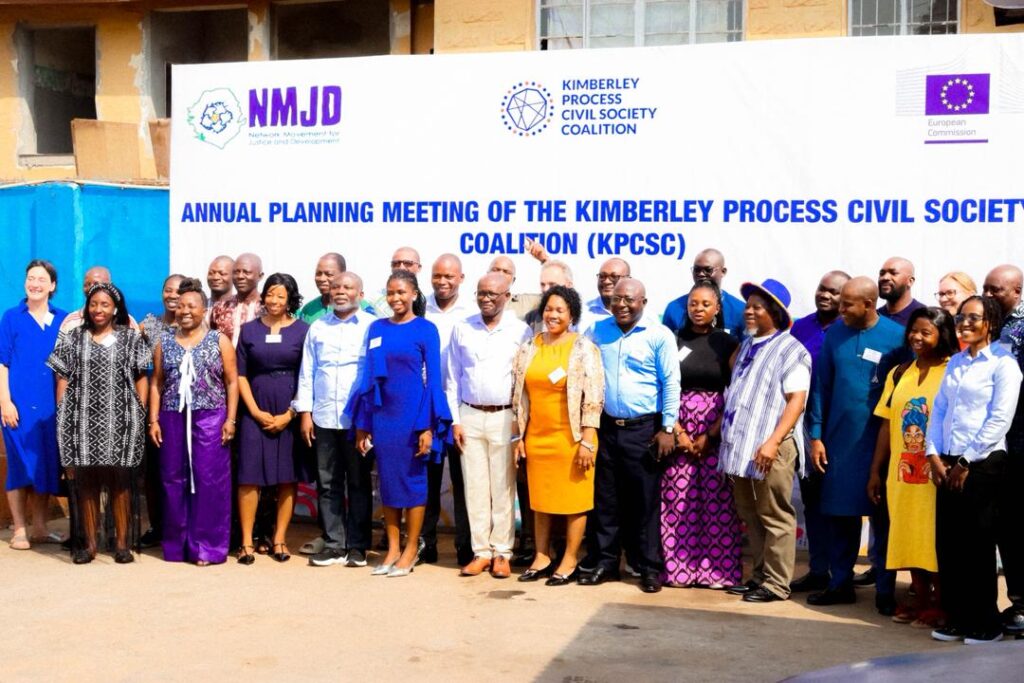
The Kimberley Process Civil Society Coalition (KP CSC) Annual Planning Meeting in Freetown, Sierra Leone, convened at a critical moment for diamond governance globally. Held under the theme “Sustainability for Greater Impact,” the meeting provided space for reflection on the future of the Kimberley Process (KP), the evolving political economy of mining, and the role of civil society as both watchdog and solution-builder in increasingly constrained civic spaces.
Mining remains central to Sierra Leone’s development trajectory, particularly diamonds, yet understanding recent shifts in the sector has become more complex. Discussions highlighted pressures arising from declining diamond revenues, changing global demand, and debates around sovereign wealth and long-term fiscal stability.
According to data shared during the meeting, KP Focal Point, Mohamed Bah, Director of Precious Minerals Trading at the National Minerals Agency (NMA), Sierra Leone’s diamond exports declined sharply, from approximately US$102 million to US$19 million, representing a reduction of over 300 percent in export value, placing significant strain on public finances. This volatility has reinforced calls to strengthen domestic value addition and rethink dependence on raw mineral exports.
Speakers such as Jaff Bamenjo, outgoing KP CSC coordinator, emphasized that the coalition’s strength lies in its independence and ability to set its own agenda, with support from partners such as the European Union.
Beyond diamonds, the coalition increasingly situates its work within broader mineral resource governance (MRG) debates, recognizing that the limitations of KP certification, which alone cannot address governance failures across extractive sectors. The inability of the KP to consistently prevent conflict diamonds from entering global markets underscores the urgency of reform.
The KP itself was described as at a crossroads. Ongoing disagreements at KP plenaries over the definition of “conflict diamonds” continue to undermine its credibility. Current definitions fail to adequately capture human rights abuses, governance-related violence, and state-linked militarization, allowing ambiguity to compromise accountability.
Participants argued for a universal definition that reflects contemporary realities, where harm is not limited to armed rebel movements but often embedded in state-corporate arrangements.
At the same time, the meeting situated diamonds within a rapidly changing global mining landscape. The rising importance of critical minerals, coupled with intensifying geopolitical contestations, is reshaping extractive priorities across Africa. This shift is occurring alongside a shrinking civic space and the rise of authoritarian governance, placing civil society under pressure while increasing the stakes of resource governance failures.
Bah reaffirmed Sierra Leone’s commitment to responsible mining practices, including reforms under the Mines and Minerals Act of 2023, which strengthen community consultation requirements. However, persistent challenges remain at the community level, particularly around artisanal mining, environmental degradation, taxation, and revenue sharing, where affected communities continue to receive limited benefits from extraction.
These dynamics carry important lessons for Zimbabwe. Like Sierra Leone, Zimbabwe faces declining returns from diamonds, weak transparency, and unresolved community grievances, particularly in Marange. Massive retrenchments by the state-owned mining company Zimbabwe Consolidated Diamond Company (ZCDC), which reportedly laid off over 500 workers in 2025, are indicative of the sector in turmoil.
Governance gaps in taxation, revenue disclosure, environmental protection, and benefit-sharing persist, while communities bear the social and ecological costs of extraction. Zimbabwe’s experience further illustrates how certification without accountability fails to deliver justice or development.
For Zimbabwean civil society and policymakers, the discussions in Freetown underscore the need to reaffirm the core objective of the KP: preventing the trade in conflict diamonds, while pushing for enhanced traceability systems that incorporate human rights and community evidence. They also point to the importance of exploring responsible investment and value addition strategies to buffer against market volatility and production shocks.
Ultimately, sustainability for greater impact will depend on whether the KP CSC and its partners can reposition diamond governance away from narrow compliance toward people-centered accountability, while remaining alert to the broader extractive transitions shaping Africa’s future.
For Zimbabwe, as for Sierra Leone, the path forward lies not only in reforming the KP but in ensuring that mining serves communities, strengthens fiscal stability, and contributes meaningfully to long-term development.