
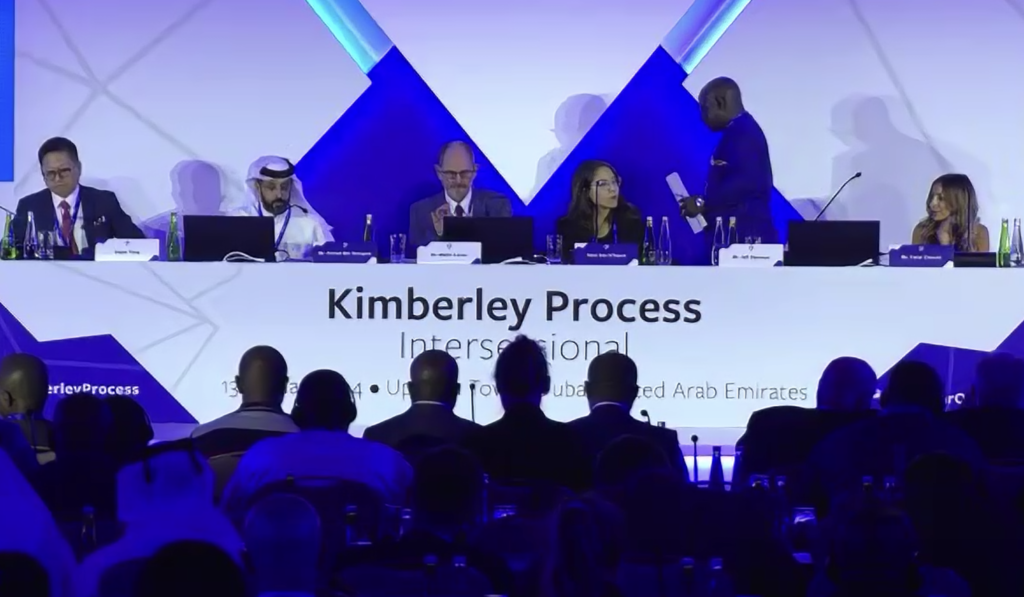
KP Civil Society Coalition (CSC) awaits real change that puts communities impacted by diamond mining at the centre of reforms and diamond governance.
As delegates representing 85 countries, civil society, and the diamond industry gathered in Dubai from 13-17 May at the Intersessional meeting of the Kimberley Process (KP), civil society says the meet recorded fragile progress while largely stalling on the finalization of long overdue reforms.
Despite pronounced overtures to reforms with leadership enunciating a commitment to autonomous operations of the Kimber Process, civil society remains critical of the stalled reform progress.
The KP leadership acknowledges this. In a press statement on the eve of the meeting, it said in the eyes of civil society, reform ambitions contrast sharply with the bleak reality of a paralyzed KP system that has failed to transform.
KP said, repeatedly, it has been ‘unable to address, or even only discuss, challenges at the core of its mandate, even as this year’s chairperson from the United Arab Emirates (UAE), Mr. Ahmed Bin Sulayem, expressed great ambition.
Sulayem says he wants his leadership to mark the ‘year of delivery’ by “solidifying KP’s ability to operate autonomously and with greater efficiency.”
“This KP meeting should be a forum to evaluate the state of diamond governance, assess whether conflict diamonds are effectively banned from international trade, and give a final push to the ongoing and much-needed KP reform cycle,” said Sulayem.
In sentiments expressed at the end of the Intersessional meeting, the KP CSC Coordinator, Jeff Bamenjo, said civil society only recorded nominal progress without tangible reforms to transform current-day diamond governance, system, and structure of the certification process.
Bamenjo said testimony from affected communities was a significant breakthrough for the Central African Republic (CAR), which has been under KP restrictive measures since 2013. Civil society has previously expressed its deep concern over the KP’s failure to seriously assess its role in exacerbating or alleviating ongoing conflicts, in particular, Russia’s aggression against Ukraine and the enduring conflict in CAR.
The KP has been condemned for failing to address the root causes of the conflict, with its imposition of an embargo on diamond exports from the CAR, inadvertently transforming the country’s diamond sector into a magnet for conflict profiteers, criminal networks, and mercenary groups seeking to generate and launder illicit funds.
“We are encouraged by the incremental, albeit fragile progress made regarding the Central African Republic (CAR), which has been under KP restrictive measures since 2013. The renewed engagement of the CAR government with the KP Monitoring Team signifies a positive shift towards cooperation,” says Bamenjo.
Another significant reform was the is the adoption of the concept of Co-chairmanship which could allow smaller countries to assume the role of chair, which sets a platform for the implementation of a peer review mechanism.
“Civil Society Coalition is happy at the significant breakthrough during this intersessional meeting. It occurred on day one: for the first time in its history, the Kimberley Process (KP) invited communities to testify about the impact of diamond mining on their lives, even though some participants were threatened by the “truth” in the room.
“The community representatives unveiled how current-day conflict is not only about rebels but also about broken promises, forced relocation, house destruction due to blasting, poor living conditions, environmental degradation, and violence against artisanal miners,” states the KP CSC.
The KP’s failure to provide a forum for discussion and cooperation on this pressing trade issue has significantly contributed to the turmoil and uncertainty currently pervading the supply chain.
As a global, UN-mandated scheme, to break the links between diamonds and conflict, the KP at the very least should offer a forum to address and discuss these concerns, explore different perspectives, and seek common ground.
Civil society strongly contends that both the KP and the CAR government can and should do much more to mitigate the negative impacts of the embargo on artisanal mining livelihoods. This should make the country and local communities the beneficiaries of CAR’s natural resources endowments, not rebels and mercenaries.
According to the KP CSC the current crisis of the diamond trade calls for urgency in expanding the long-outdated definition of conflict diamonds, seen as serving ‘an unambitious status quo,’ and allowing violence and human rights violations along the supply chain to go unnoticed for consumers.
“The change in definition must be done and it has to be real. It is not a matter of choice, but a necessity for the KP to survive,” says Bamenjo.
As diamonds stained by violence, social economic injustice, and environmental damages proliferate the supply chain, communities remain peripheral to reforms when they should be beneficiaries of natural resources.
The KP should embrace a much more comprehensive approach, not just banning diamonds funding rebel groups, but also harnessing diamond mining to drive development and enhance the economic, social, and physical well-being of communities.
Critics condemn the KP lenient and box-ticking peer review process which should evolve into a transparent and robust mechanism that ensures progressive country improvement to achieve “greater efficiency.”