The global extractive economy is at a crossroads, but for resource-rich countries, the central question remains unchanged: who controls the wealth, who benefits from it, and who bears the cost?
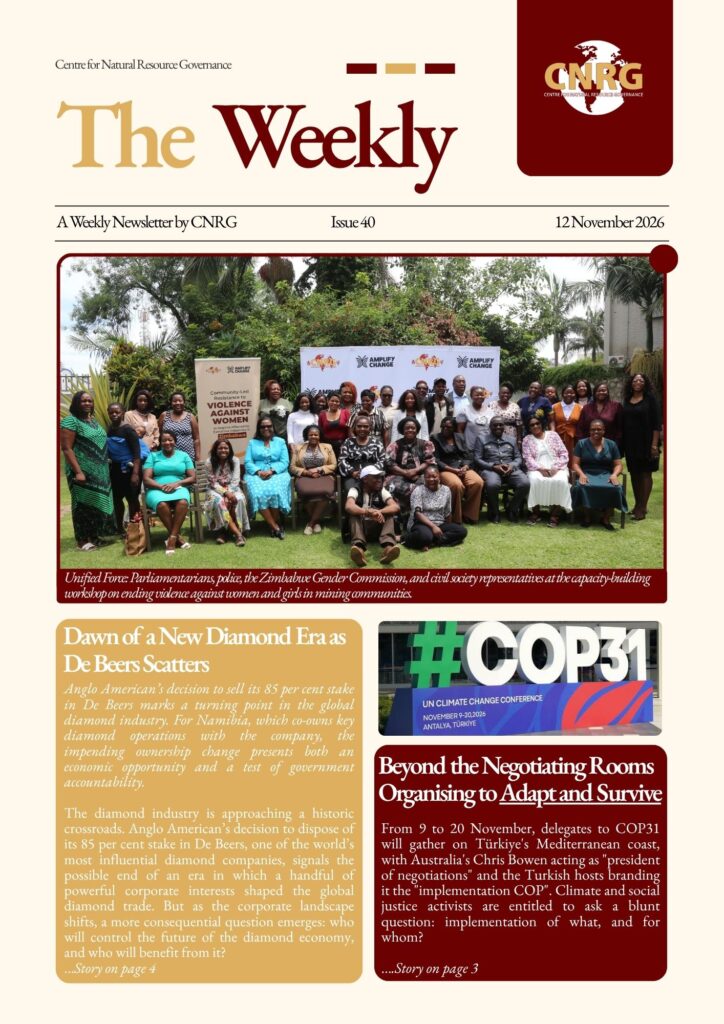
This 40th edition of The Weekly examines the shifting dynamics of mineral ownership, the contradictions of the global energy transition and the persistent governance failures that continue to undermine communities living in resource-rich areas.
Anglo American’s decision to divest its 85 per cent stake in De Beers signals a potentially defining moment for the diamond industry. For Namibia, it presents an opportunity to reconsider its position in the diamond value chain and pursue greater economic sovereignty. Yet, as the article argues, a change in corporate ownership does not automatically translate into national prosperity. Without transparency, strategic leadership and public accountability, one powerful corporate interest could simply be replaced by another.
As COP31 unfolds in Antalya, the contradictions of global climate politics are equally difficult to ignore. While governments negotiate climate action, fossil fuel interests continue to shape the pace and ambition of the transition. For Africa, the challenge is not merely to participate in these conversations but to demand adaptation finance, equitable access to technology and greater value retention from the critical minerals powering the green transition. Communities already confronting droughts, food insecurity and environmental degradation cannot afford promises that arrive after disaster strikes.
Closer to home, Zimbabwe’s mining governance faces another test. Reports of alleged immigration irregularities at Bikita Minerals raise questions about the enforcement of labour and immigration regulations. Foreign investment must not create parallel systems of accountability in which companies enjoy privileges unavailable to ordinary citizens. Investment should complement national development priorities, create decent employment and operate within the country’s laws.
The vulnerabilities of women in mining communities also demand more than policy declarations. Our coverage of the two-day engagement involving Parliament, government institutions, police, civil society and mining-affected communities in Marange and Hwange highlights the importance of institutional coordination and accountability in confronting gender-based violence. Protecting women requires more than encouraging survivors to report abuse. It demands confronting the economic inequalities, unsafe environments and unequal power relations that enable exploitation in the first place.
Meanwhile, the situation in Imbeza Valley near Penhalonga illustrates the consequences when communities feel compelled to defend their water, land and livelihoods against disputed extractive activities. Residents’ petition over suspected illegal alluvial mining raises troubling questions about regulatory oversight and the possible misuse of environmental rehabilitation initiatives. River rehabilitation must restore ecosystems, not become a convenient pathway for mineral extraction.
Across these stories runs a common thread: natural resource governance is ultimately about power, accountability and the protection of people’s rights. Whether in the boardrooms of global diamond companies, the negotiating halls of climate conferences or the mining landscapes of Zimbabwe, development cannot be measured by investment figures, mineral output or export earnings alone.
At CNRG, we maintain that natural resources must serve the public interest. Communities are not passive spectators in decisions affecting their land, water, livelihoods and futures. They have a right to information, meaningful participation and accountability from both governments and corporations.
The question is not simply how much wealth extraction generates, but whether that wealth translates into dignity, justice and sustainable development for the people who live closest to it.
#PeopleOverProfit.