
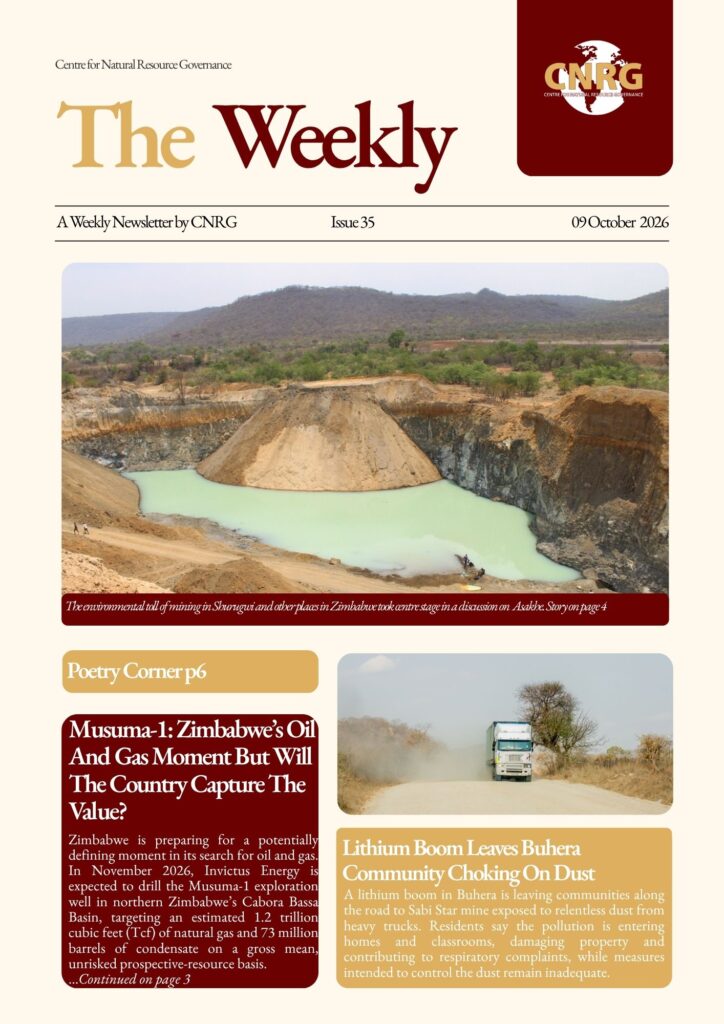
Mineral Wealth Must Deliver Public Value
This edition returns to a question that Zimbabwe can no longer afford to postpone: who truly benefits from the country’s mineral wealth? Across Bikita, Buhera, Penhalonga and the emerging Cabora Bassa petroleum frontier, the same tension is visible. Investment is advancing, production is expanding and new infrastructure is being announced, yet communities continue to ask for basic information, meaningful participation and protection from the costs of extraction.
The rehabilitation of the Sosera–Ndambani road is welcome, but public celebration should be matched by public disclosure. Communities deserve to know the project’s cost, scope, timetable and how it was prioritised. In Buhera, the dust generated by heavy traffic serving Sabi Star shows why corporate promises must be measured against lived experience. A mine may create jobs and export earnings, but those gains cannot excuse preventable harm to homes, schools and public health.
The warnings from civil society are therefore timely. Responsible mining requires more than occasional donations or projects selected without transparent consultation. It requires enforceable environmental standards, access to information, credible monitoring, community consent and clear systems for returning a fair share of mining revenue to affected areas. Where levies are collected in the name of communities, government must explain how much has been received, where it is held and when it will be disbursed.
The concerns raised in Parliament over Christmas Pass and Penhalonga add urgency. Allegations that mining continues despite official directives, alongside reports of severe injuries and environmental danger, demand prompt, documented responses from the responsible ministries. Regulatory uncertainty benefits neither communities nor legitimate investors. Rules must be clear, consistently enforced and backed by institutions with the capacity to investigate and act.
Musuma-1 extends this debate beyond mining. If commercially recoverable oil and gas are discovered, Zimbabwe will face decisions whose consequences may endure for generations. The country must prepare before discovery, not after it, with transparent agreements, a coherent fiscal regime, environmental safeguards and an industrial strategy that supports power generation, local procurement, skills development and domestic value addition. Geological success alone will not guarantee national progress.
The central message of this edition is simple: extraction must be governed in the public interest. Roads, clinics and jobs matter, but they should not replace accountability, lawful conduct or citizens’ rights. Zimbabwe’s resources can support broad-based development only when communities have a voice, companies meet their obligations and public authorities disclose decisions and enforce the rules without fear or favour. Mineral wealth becomes a blessing not when it leaves the ground, but when its value is converted into safer communities, stronger institutions and lasting opportunity.