

By Donald Nyarota
In Mutare, against the backdrop of Zimbabwe’s eastern highlands, where gold panning, quarrying and riverbed extraction increasingly shape local livelihoods, a recent training under the ENABLE project to cast a sharp light on a quieter crisis: mining-induced internal displacement.
Community members were drawn from Penhalonga and Marange communal lands.
The training was not merely technical. It was empowerment in the broadest sense, concerned with power, rights and the uneven geography of development. Participants reflected on lived experiences from across Manicaland and beyond, where mining expansion has redrawn boundaries, displaced households, and disrupted social systems built over generations.
In these accounts, displacement is rarely dramatic; it unfolds incrementally, through notices, negotiations and, often, coercion disguised as consent.
This reality stands in tension with the ambitions of the Africa Mining Vision (AMV), which imagines a mining sector that is transparent, equitable and rooted in community development. The ENABLE training exposed the distance between this continental aspiration and Zimbabwe’s local practice. Rather than anchoring inclusive growth, mining is too often experienced as exclusion, particularly by rural communities whose tenure systems remain weakly protected.
A central theme of the discussions was the absence of a robust legal framework to govern internal displacement. Zimbabwe is a signatory to the Kampala Convention, a landmark agreement that obliges states to prevent displacement and protect affected populations. Yet, as participants repeatedly noted, this commitment remains undomesticated, leaving communities without enforceable safeguards.
The convention, often referred to as the Kampala Declaration in policy discourse, sets out clear obligations for member states: to prevent arbitrary displacement, including that caused by development projects; to protect and assist internally displaced persons during displacement; and to ensure durable solutions, such as safe return, local integration, or resettlement with dignity. It further requires states to establish legal and institutional frameworks that guarantee consultation, compensation, and accountability.
Crucially, it recognises that development-induced displacement, including from mining, must be managed in a way that prioritises human rights and community consent, not treated as an inevitable by-product of economic progress.
The implications are practical and immediate. Without domestication, there is no standardised process for consultation, compensation or resettlement. Each displacement case becomes an isolated negotiation, often tilted in favour of investors and state interests. For CBOs and CSOs, this creates both a challenge and an opportunity: the need to shift from reactive advocacy to proactive legal and policy engagement.
It was within this context that Freeman Bhoso’s intervention resonated strongly with participants:
“We need this to be moved through the responsible parliamentary portifolio committee or even have a privately moved bill because everyone in Zimbabwe has the possibility to be moved from our commons.
“Zimbabwe is resource endowed country, but our country signed the Kampala declaration yet it is not domesticated into a law.”
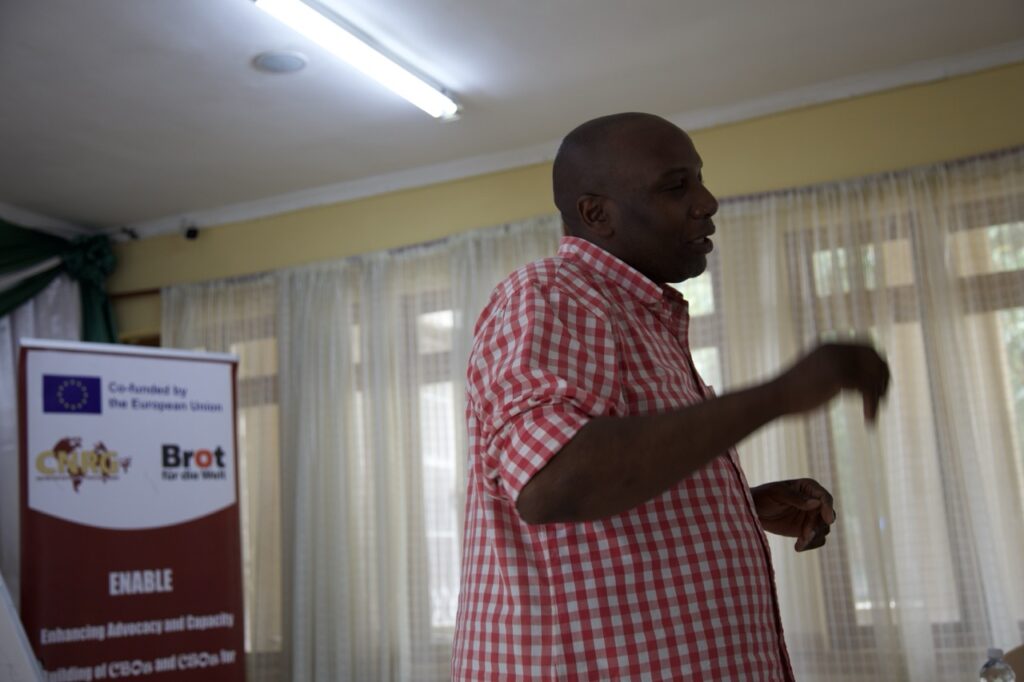
Mr Freeman Bhoso of the Zimbabwe Natural Resources Dialogue Forum
His remarks captured the training’s underlying message, that internal displacement is not a marginal issue, but a systemic risk embedded in Zimbabwe’s extractive model. As new mineral discoveries accelerate interest in previously untouched areas, the threat of relocation extends beyond traditional mining zones, touching communal lands across the country.
The ENABLE project, in this sense, is as much about reframing narratives as it is about building capacity. By equipping local actors with the language of rights, policy frameworks, and advocacy strategies, it seeks to bridge the gap between communities and decision-making processes. Crucially, it positions displacement not as an inevitable by-product of development, but as a governance failure that can, and should, be addressed.
If the Africa Mining Vision is to move from aspiration to reality, the lessons from Mutare are clear. Legal reform, particularly the domestication of the Kampala Convention, must be prioritised. Equally important is the strengthening of community voices, ensuring that those most affected by extraction are not merely consulted, but meaningfully involved.
Otherwise, Zimbabwe risks deepening a familiar paradox: a country rich in minerals, yet marked by communities in motion, displaced not by conflict, but by the very resources meant to secure their future.