
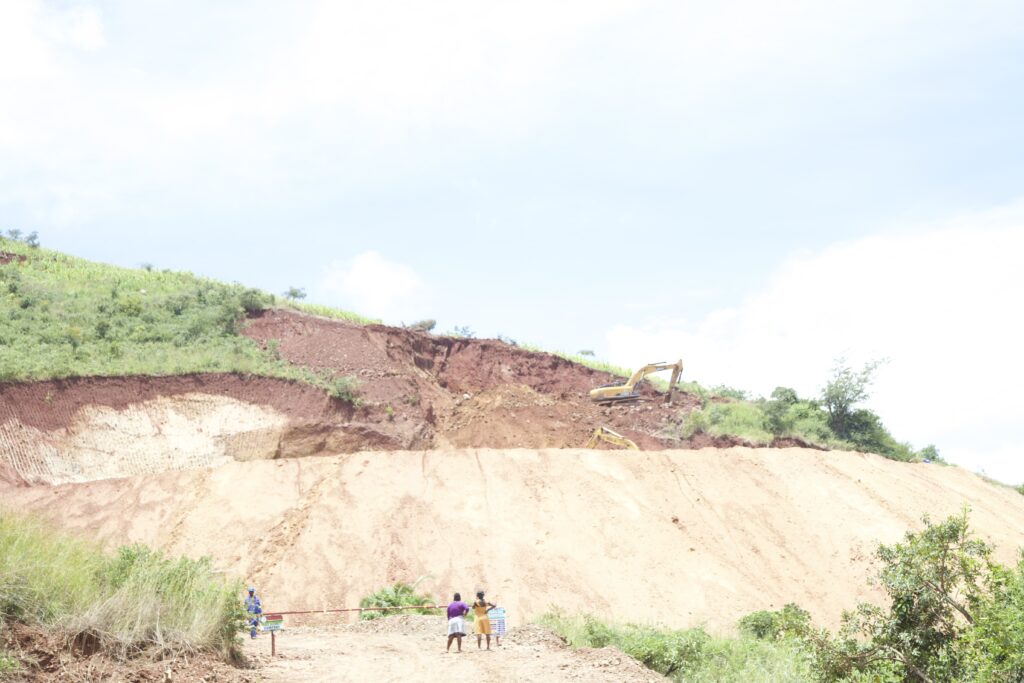
The mountain did not invite the miners, but they came anyway, with machines, with political backing, and with promises wrapped in the language of “compensation.” They invaded a mountainside housing water tank for Tsvingwe residential area in Penhalonga.
The mining operation is fronted by Better Brands Mining Company, owned by ZANU PF politician Scott Sakupwanya, in partnership with a Chinese entity. When The Weekly visited the site, Chinese nationals were seen operating heavy machinery, excavators clawing at earth that villagers say they were never properly consulted about surrendering.
The company maintains it holds an Environmental Impact Assessment (EIA) certificate. Yet residents say they were not consulted before operations began. Consultation, in this case, appears to have followed the arrival of machinery.
Farai Maguwu, executive director of the Centre for Natural Resource Governance (CNRG) addressing a community meeting, placed the current tensions in historical context.
Mining in the past fronted by Redwing Mine, he noted, was largely underground and did not visibly fracture the landscape or destabilise surrounding mountains. Today’s methods are different, more aggressive, more expansive, more destructive.
“The current mining practice threatens the structural integrity of the surrounding mountain,” he said.
Then he turned to the community itself.
“The actions of the community show that you are aware of your rights. As a community, you have the power to either accept or reject the mining project.
“Our government is very much aware of this criminal activity and the laws, but they will not do anything until the community rises up and speaks with one voice.
“The voice of the community is the only voice that can save this place.”
When reached for comment officials from the company, that addressed the community, a Colonel Gladman Chimonyo insisted the matter was already resolved. The community, he said, had been paid.
“They have already been compensated. They were signing for their compensation. We can give you a list of those that have benefitted from this exercise. We will be compensating the community as we go with our mining activities, as and when they are affected.”
But on the ground, the story is far less tidy.
Villagers who spoke to The Weekly say what is being called compensation feels more like coercion, hurried signatures, lump-sum payments, and no meaningful consultation about the scale of what is coming.
“They just called me and told me to sign for $300 for the hectare of my field that was affected,” one community member said. “They made it seem like they were doing me a favor. But it’s once off. I feel shortchanged. We will get nothing from this while they make money.”
Three hundred dollars for land that has sustained families for years. A single payment for fields that produce harvest after harvest. Once the money is spent, the mine remains.
For some, the issue is not just inadequate payment but intimidation. Community members report being threatened when they attempted to engage the company. They named officials, including individuals identified as Clinton and Chinhamora, as having made them feel unsafe. In a context where political power and mining interests are tightly woven, fear is not abstract, it is immediate.
On paper, compensation has been paid. In reality, resentment simmers.
The machines continue to dig. The mountain continues to shake. And the community, offered $300 for a hectare and told the matter is settled, is left to decide whether this is development, or dispossession dressed up as progress.