
The Human Cost of Extractive Wealth
When the Ground Gives Way, Accountability Must Rise
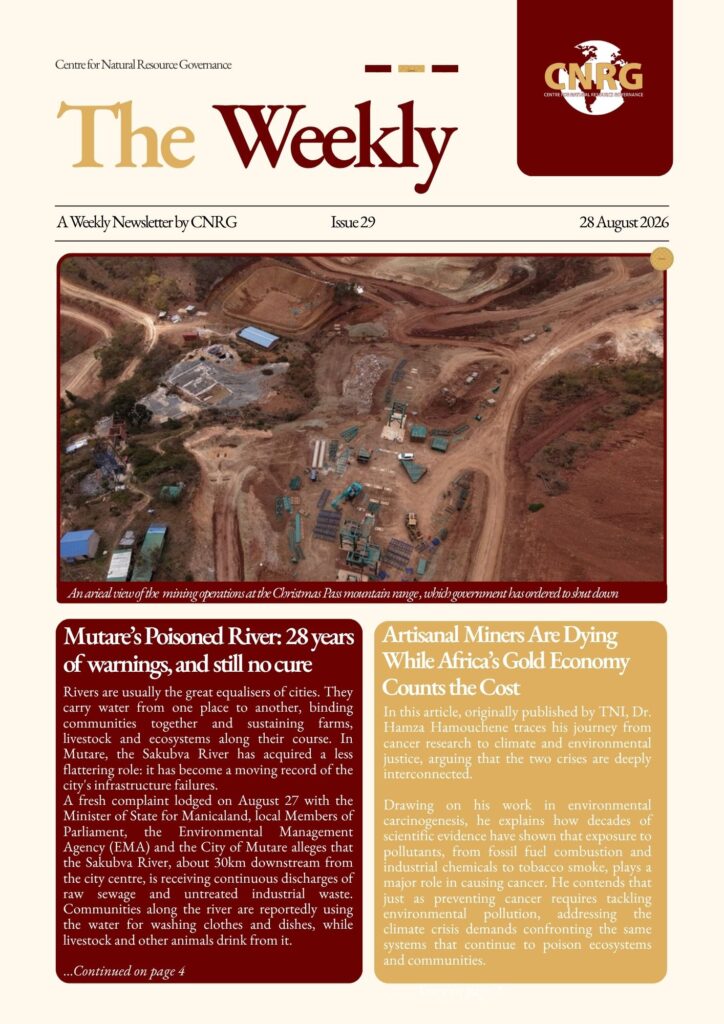
Zimbabwe’s extractive economy is often discussed in the language of production, investment and national revenue. This edition of The Weekly asks a more fundamental question: who bears the cost when mineral wealth is extracted without adequate protection for people, communities and the environment?
The answer is increasingly visible in collapsed mine shafts, polluted water sources, displaced families, unsafe workplaces and women whose vulnerability is intensified by economic hardship and unequal power. The tragedies reported in the Central African Republic and Penhalonga are not merely unfortunate accidents. They are evidence of systems that continue to rely on the labour of artisanal miners while failing to provide the conditions necessary for them to work safely and with dignity.
Artisanal and small-scale miners are not a marginal feature of Zimbabwe’s gold economy. They are among its principal drivers. Yet the people who sustain this vital sector frequently operate without protective equipment, reliable geological information, access to finance, properly regulated sites or effective occupational health and safety systems. It is not enough for authorities to urge miners to be cautious when the wider structure leaves them with few safe choices. Responsibility must extend to governments, licence holders, financiers, sponsors, buyers and regulators who benefit from the mineral economy.
Formalisation must therefore become a practical programme of protection, not a bureaucratic exercise. A licence on its own cannot shore up an unstable shaft, provide emergency services or guarantee a fair price for gold. Formalisation must bring safer sites, enforceable standards, technical assistance, affordable finance, transparent markets and meaningful regulatory oversight. Most importantly, it must recognise artisanal miners as workers and economic actors whose lives are worth protecting—not as expendable inputs in a chain of profit.
The same principle applies to Zimbabwe’s rapidly expanding lithium industry. Lithium is central to the global transition towards cleaner energy, but the promise of a green future cannot excuse the destruction of local landscapes and livelihoods. Local beneficiation is important, yet processing minerals inside Zimbabwe will not, by itself, ensure that communities receive a fair share of the value created or that damaged land and water systems are restored.
A credible critical-minerals policy must place communities at the centre of decision-making. Environmental impact assessments must be independent and meaningful. Rehabilitation bonds should be secured before mining begins. Companies must be held responsible for restoring the land they disturb, and a fair share of mineral revenues should reach the communities that live closest to extraction sites. Consultation must take place before decisions are finalised, not after permits have been issued and the first trees have been cleared.
The concerns surrounding Toronto Mine reinforce the importance of enforcement. A cease-and-desist order is not a suggestion. If mining or processing continues clandestinely after an official directive to stop, the matter becomes larger than one company or one site: it becomes a test of whether regulatory institutions have the authority and capacity to enforce their own decisions. Partial compliance cannot be allowed to legitimise continued risk, particularly where unapproved processing equipment and potential threats to workers, neighbouring communities and the environment are involved.
Closure, moreover, must mean more than locking a gate. It must include the safe evacuation of workers, the securing of dangerous infrastructure, the management of waste and tailings, the stabilisation of disturbed land and a properly funded rehabilitation programme. The cost must not be transferred to taxpayers or communities after private profits have been realised.
This edition also reminds us that mining governance is inseparable from women’s rights and access to justice. In Penhalonga and Mutare, women described the combined effects of land dispossession, environmental degradation, economic marginalisation and gender-based violence. Their experiences demonstrate that the consequences of extraction are not distributed equally. Women often carry the heaviest social and economic burdens while having the least influence over decisions affecting their homes, livelihoods and safety.
Yet the edition offers more than a catalogue of failures. The women who moved from uncertainty to drafting their own petitions show the power of knowledge, collective action and accessible legal support. Community advocacy does not replace the duties of the state, but it can help communities claim rights, demand accountability and resist the normalisation of abuse. As the participants affirmed, no door should be treated as the wrong door when someone is seeking protection or justice.
The message running through these stories is clear. Zimbabwe cannot build a just mineral economy by measuring success only in tonnes produced, concentrate exported or gold delivered. The true measure of progress is whether mining improves lives, protects workers, respects communities, restores damaged environments and gives affected people a meaningful voice in decisions about their future.
The country has an opportunity to turn its mineral wealth into broad-based development. But that opportunity will be lost if extraction continues to be separated from accountability. No battery, bullion shipment or balance sheet is worth a miner’s life, a community’s safety or a ruined landscape. The wealth beneath Zimbabwe’s soil must not be secured at the expense of the people who live above it.