

By Staff Reporter
In the eastern province of Manicaland, where patriarchal traditions have long held sway, a quiet revolution blew through—not in the streets or in parliament, but in a communal gathering at Muparutsa Primary School, in Mutasa District. At a gathering targeting men, the event signaled the dawn of a new era in addressing gender based violence (GBV) as men took time to discuss what it means to be a man in a society striving for gender equality.
Hosted by Zimbabwe’s Gender Commission, this initiative boldly reimagined gender justice strategies, recognizing that transforming men is crucial to empowering women and achieving true equality. This district initiative was a build-up to a provincial Male Engagement Symposium, scheduled for June 2025, that will gather over a thousand men to talk, listen, and perhaps, change.
This was not a soft campaign. Its aims were solid, to confront deep-seated issues: gender-based violence, male suicide, drug abuse, and systemic exclusion of men from conversations they often dominate by silence or aggression. The approach, a blend of edutainment and earnest dialogue, from community-level listening sessions in districts like Mutasa and Chipinge, to keynote addresses and musical performances from pop celebrities expected to carry the message of “positive masculinity.”
To the uninitiated, the phrase may sound like oxymoronic NGO-speak. But “positive masculinity” here is not about emasculating men; it is about recasting their roles—from patriarchs to partners, from bystanders to allies. The policy premise is deceptively simple: gender equality cannot be achieved if half the population is treated as either an obstacle or an afterthought.
That premise is backed by data and desperation. Zimbabwe’s 2013 Constitution enshrines gender equality as a national principle, and the government’s Vision 2030 targets a middle-income economy that “leaves no one behind.” But reality remains stubborn. Men are both perpetrators and victims of the country’s overlapping crises—economic decay, mental health neglect, and cultural rigidity. They are also crucial gatekeepers in the social systems which upholds discrimination.
Hence, the 2025 symposium’s bold goal: to identify and honour “Male Gender Champions” and establish a grassroots Male Gender Forum. This was no mere talk shop. Organisers delivered both awareness and outcomes—more reporting of gender-based violence, better services for men, and fewer toxic behaviours passed off as manhood.
In many social and economic spheres, like mining, gender inequality and violence against women are festering, calling for the need for transformative actions of men who are the main perpetrators.
“The mining sector has for long been a source of systemic violence against women, and this calls for a rethink in strategies and our collaboration with the gender commission signals a strategic direction,” said Donald Nyarota, communications and advocacy officer with Centre for Natural Resource Governance (CNRG).
With support from AmplifyChange, CNRG is implementing a project Community-Led Resistance to Violence Against Women in Regions Affected by Extractive Industries in Zimbabwe, to address violence against women in mining communities.
CNRG was one of the many civic society organisations that partnered with ZGC at the inaugural district event, which was dubbed a success by the commission’s chair, Margaret Mukahanana-Sangarwe.
In her keynote address, she said, “Today’s event is a bold declaration that gender equality is not just a women’s issue it is a societal issue, it affects all of us, men are not only part of the conversation but also a key solution.
“This symposium is becoming a flagship of the commission. We have made it bigger and better because we listened, we heard the concerns, ideas, and challenges raised (by men).”
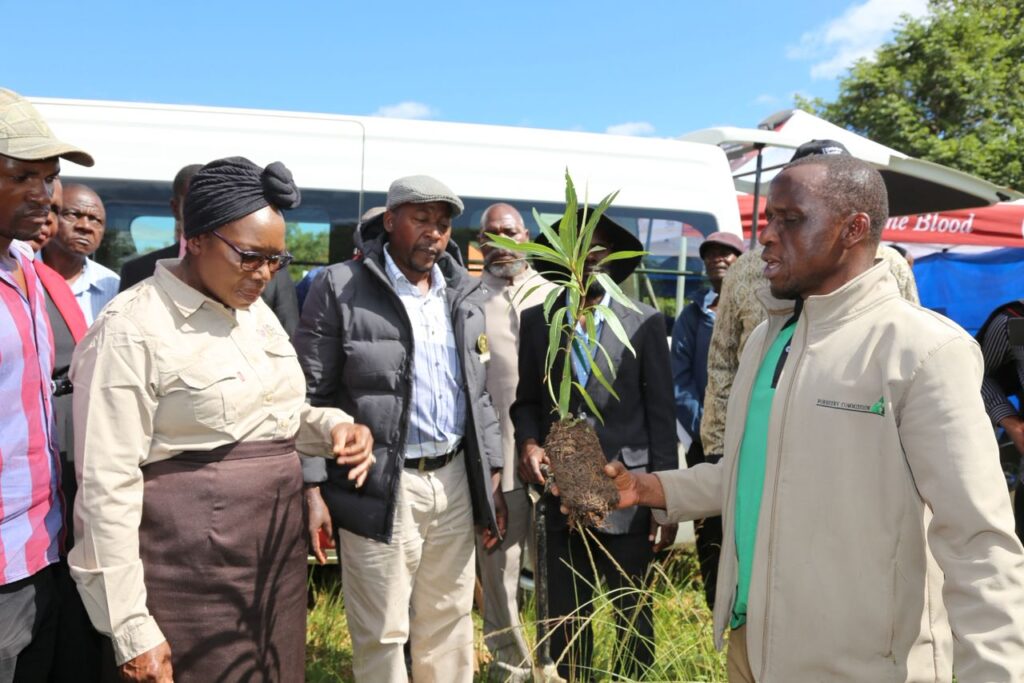
Zimbabwe Gender Commission (ZGC) chairperson, Margaret Mukahanana-Sangarwe, prepares to receive a tree seedling for symbolic planting at the Male Engagement Symposium
Sceptics may scoff. Engaging men in gender discourse has historically attracted more platitudes than progress. There is also the risk of recentring men in a space originally designed to correct the marginalisation of women. But the Gender Commission, at its 10th anniversary, seems aware of the balance, with its focus on strategic partnerships, inclusive dialogue, and accountability.
Zimbabwe is not alone. Countries from Rwanda to Sweden have experimented with involving men as allies in equality campaigns, with mixed but promising results. What makes the Manicaland model noteworthy is its localisation: from engaging men living in grassroot communities to collaborative efforts including civic society organisation and the private sector it’s a holistic approach. It treats masculinity not as a monolith, but as a contested, evolving identity—worthy of state-level attention.
If this gamble works, Zimbabwe could offer a blueprint for how fragile states can address gender justice not only by empowering the vulnerable but by rehumanizing the powerful. If it fails, the country risks another well-intentioned policy buried under a pile of dusty certificates and expired refreshments. Either way, the mirror has been handed over. What men choose to see—and change—will determine whether this moment becomes movement