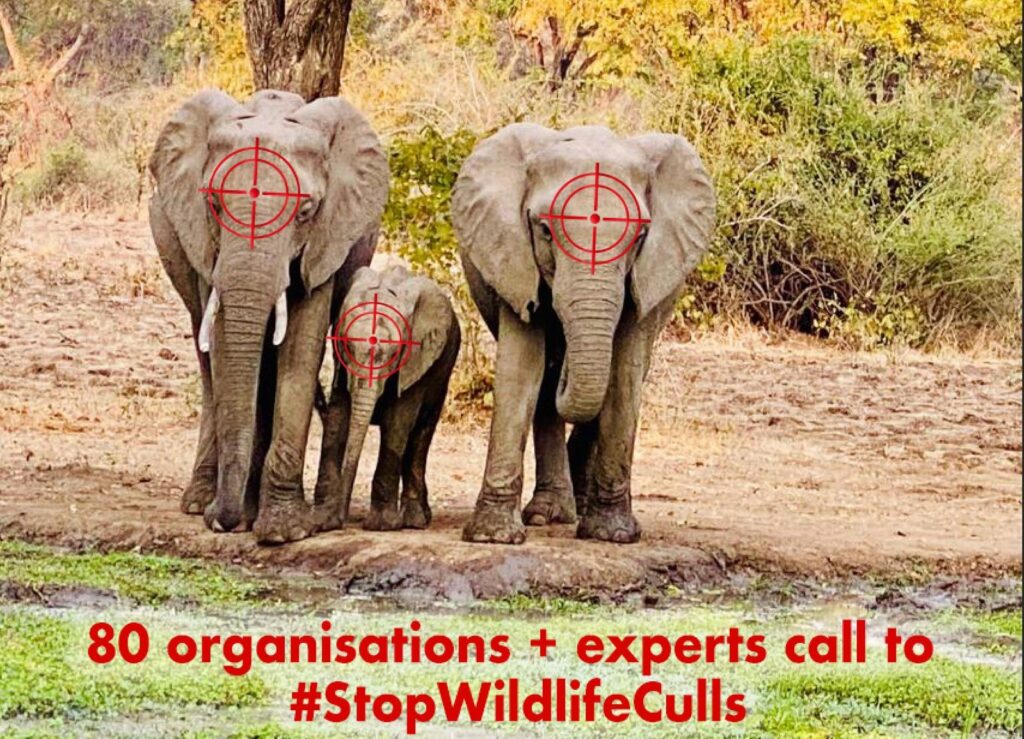
23 October 2024 – The undersigned organisations are deeply concerned by the announcements by some governments in southern Africa to cull large numbers of elephants and other wild animals, including in National Parks.
In late August 2024, Namibia declared it would kill 723 wild animals, including 83 elephants and later increased this number to 100. Shortly afterward, Zimbabwe announced its intention to kill at least 200 elephants.
The justifications given for these threats include a combination of providing meat to drought-stricken citizens, reducing pressure on land and water resources, mitigating human-elephant conflict, and reducing alleged wildlife over-population.
However, while we acknowledge the severity of one of the worst droughts in decades in southern Africa, the killing of large numbers of wild animals cannot be justified for the following reasons:
- Culling fragile wildlife populations to feed people is not sustainable and cannot provide food security to millions of people requiring food assistance during a prolonged drought. The distribution of game meat also generates a demand that cannot be met sustainably in the long term, thereby potentially fueling poaching and illegal trade.
- Culling does not resolve human-wildlife conflict. Rather, it further threatens fragile wildlife populations, fractures the social structure and stability of wildlife populations (e.g. of elephants), traumatizes surviving animals, and can lead to aggression towards humans thereby increasing future conflict.
- The slaughter of elephants results in the stockpiling of tusks, increasing the pressures to undermine international bans on ivory trade and open up ivory markets. We are concerned that Namibia and Zimbabwe have been at the forefront of efforts to reverse the international ban on ivory trade in order to generate income. This would inevitably fuel demand and increase poaching pressure with devastating consequences for remaining elephants across their entire range.
- Killing wild animals that are the basis for the tourism economy would threaten sustainable livelihoods. In Zimbabwe, tourism is the third largest economic sector and contributed US$ 433 million to the country`s GDP. This industry is heavily reliant on healthy wildlife populations and intact protected areas and could suffer significantly from the culling of wild animals.
- The move to cull elephants is a major policy reversal. It was carried out in Zimbabwe and South Africa between the mid-1960s and the mid-1990s but was abandoned after heavy criticism because of the cruelty and trauma inflicted on these highly intelligent and social animals.
- African savanna elephants are categorized as Endangered in the IUCN Red List of Threatened Species. Their populations have declined by at least 60% across the continent over the last 50 years. While southern Africa has been less affected by these declines and is home to the largest populations of savannah elephants, claims of recent population growth and over-population have no scientific basis. Recent studies show that the populations in southern Africa have remained largely unchanged since 2014.
We are concerned that the proposed culls may ultimately serve the interests of those who stand to benefit from the commercial exploitation of threatened wildlife populations.
A number of experts and organisations based in southern Africa have publicly expressed concerns regarding the proposals, including the Centre for Natural Resource Governance (CNRG) in Zimbabwe, the Zambia-based organisation African Rivers, and the South Africa-based Pro Elephant Network.
The current drought affecting parts of southern Africa is devastating for both people and wildlife. Nevertheless, the governments of the countries concerned are not devoid of resources to implement effective measures to address the problem and should use the drought as an opportunity to employ stronger land governance and prioritise sustainable agricultural production among smallholder farmers in rural areas.
We note that experts have suggested a number of rational and sustainable alternatives to address the effects of the drought, most importantly the provision of staple food such as grain to ensure food security. Also, a wide range of measures and policies are available that have been proven to be effective in preventing and solving human-wildlife conflict without resorting to the indiscriminate killing of wild animals. These measures should be explored and implemented before any lethal interventions are considered.
We call on the governments of the countries concerned to withdraw plans to cull elephants and other wildlife, and instead to use their available resources to implement existing, well-proven alternative, sustainable and humane measures to tackle the current challenges facing both people and wildlife.
We also call on donor governments and agencies to link the provision of aid to the implementation of effective and sustainable measures to ensure food security and human-wildlife coexistence, while also protecting increasingly threatened wildlife populations.