
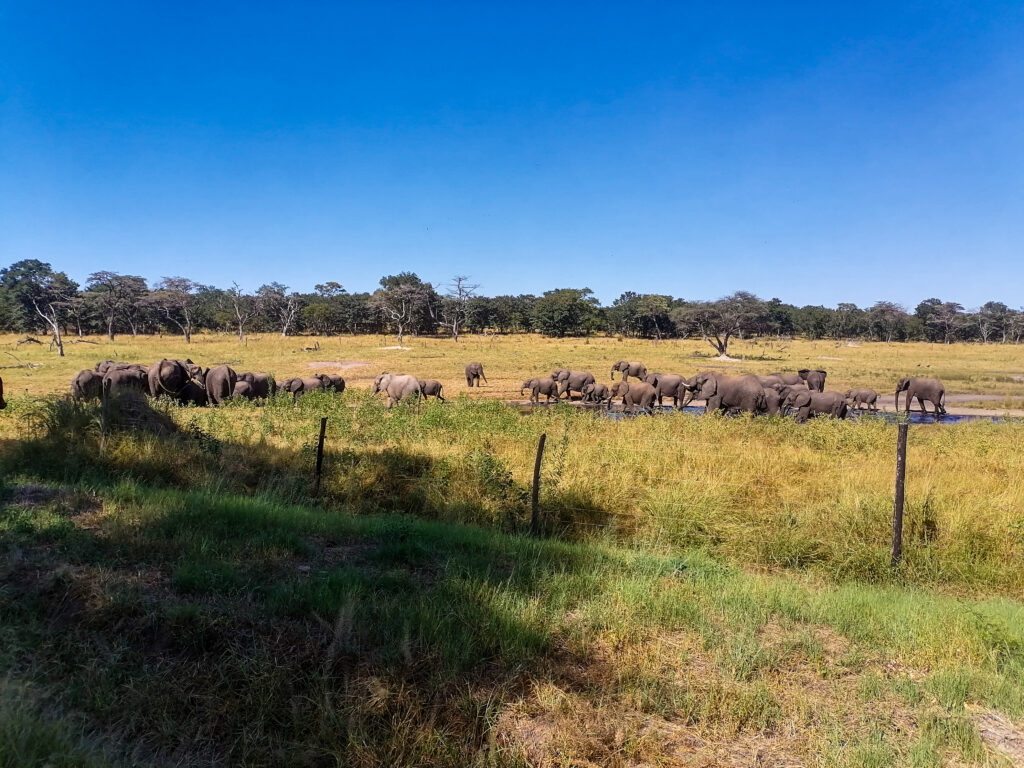
Elephants are wreaking havoc in Hwange’s Lusumbami area where the big wild beasts have come into villages from their traditional natural habitat as a result of the expansion of mining activities into areas close to the Hwange National Parks’ precincts.
In Hwange, human-animal conflict has become frequent due to direct interactions or competition for resources between humans and wildlife.
Crop raiding by elephants is now a common form of human-wildlife conflict in Hwange. Elephants are leaving the Hwange National Park in search of food, destroying crops and threatening the livelihoods of local populations. This has resulted in conflict between humans and elephants.
Harriet Nyathi (45), a Lusumbami Ward 12 resident, said that while elephants were once spotted deep in the forests, they have recently moved into villages where human-wildlife conflict is now prevalent.
Explaining the predicament of her community she said,
“Human-wildlife conflict is becoming a problem in our areas as a result of wildlife animals, notably elephants, running away from mining operations within parts close to the Hwange National Park. These animals are damaging communal vegetable gardens as well as the surrounding vegetation. These elephants are also threatening nighttime movements, which has made it difficult for individuals who finish work after 9 p.m. to walk back home safely. Some are attacked by these elephants.”
The National Parks officials have been called several times to deal with the elephants’ encroachment to prevent conflicts.
However, the community members of Lusumbani said the Parks rangers often respond saying that they lack the resources and a vehicle to attend the scenes of wildlife that would have encroached into the communities.
“We once requested that the Zimbabwe National Parks officials come to chase some elephants that we had seen in the neighbourhood. However, the parks officials complained of fuel challenges and asked the locals to pick them up and accompany them to their firearm storage place before attending to the scene. The community did not have the resources either.”
“Things have been difficult because communities lack the means to support Parks staff in doing their work,” added Nyathi.
Because of extensive tree-cutting and ecosystem disruption caused by mining activities inside Hwange National Parks, more animals are encroaching into human settlements.
Speaking to THE WEEKLY, Letwin Govere (39) of Prospect Suburb, Ward 8, in Hwange, revealed that there are now problems with baboons too, which were not previously a serious challenge.
“In our area, baboons are suddenly becoming a problem. Recently, they invaded my house, ruining food storage units, curtains, the roof, and the ceiling, and depositing waste all over the place. This is mostly due to the growing number of mining companies that are invading habitats of animals and destroying their food supplies, forcing the baboons to seek food in people’s homes,” said Govere.
Investigations by THE WEEKLY uncovered odd mining operations by the Turbo and Chaba mines close to protected areas of the Hwange National Park, which is pushing animals away from their natural habitat.
The other mines scaring away animals from Hwange Game Park include Western Energy which is near the wildlife sanctuary. This one is in the buffer zone of the wildlife game park.
There is also Makomo Resources and Zambezi Gas. These two mining companies are adjacent to the Sinamatela National Park area.
The blasting done during mining operations scares the wildlife. As a result, the animals are encroaching into communities, causing human-wildlife conflict.
Elephants have had to move into communities as a result of the blasting sounds from the mining operations. In turn, predators such as lions and hyenas have also migrated, following the heads of elephants that attract zebras and other small wild animals which they prey on for meat.
Because of this, there is now a serious risk of increased attacks of humans by both elephants and predators in the settlements encroached by the wild animals.
CNRG Matabeleland Field Officer Ndaizivei Garura said it is critical to address human-wildlife conflict in a way that ensures the safety of both humans and wildlife while also developing long-term solutions for peaceful cohabitation.
“To protect both the animals and the people in the area, Hwange National Park and the surrounding communities must continue to collaborate in order to manage and reduce these conflicts,” she said.
CNRG has been advocating for the sustainable management and conservation of ecosystems for the benefit of local communities in Hwange through its Ecosystem: Wildlife and Forestry strategy pillar.