
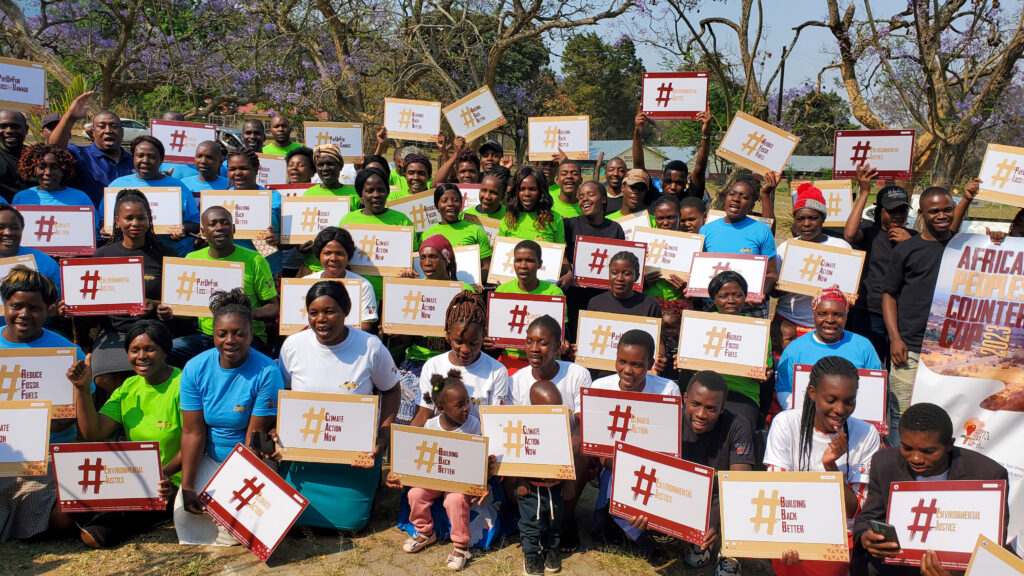
TaCCET-ZIM this week held a commemorative climate disaster preparedness workshop in Mutare to remember those who died during Cyclone Idai which ravaged Chimanimani and Chipinge 4 years ago.
Local government representatives, members of civil society, and community members from Ngangu and Kopa, the two Chimanimani places hardest hit by the cyclone were all present during the workshop which was marked by lively presentations and participation.
By educating the local population on the link between climate change and the extraction of mineral resources, as well as the detrimental effects this has on human health, the environment, and livelihoods, the goal of the workshop was to create a local community COP that comprehends the dynamics and geopolitics of climate change.
In his opening remarks at the workshop, CNRG executive director Farai Maguwu explained that the event had been organised in conjunction with a consortium of other civil society organisations coalescing under the banner of the Tackling Climate Change and Energy Transitions in Zimbabwe project (TaCCET-Zim) which is determined to promote climate justice.
“The target is to demystify climate change in our communities so that people really understand better this phenomenon. In organising this workshop, we also targeted at ensuring that participants mostly from Chimanimani who were affected by Cyclone Idai get to share their experiences and get the relief they need in the wake of the disaster that befell them four years.,” he said.
He said it is important for participants to know that climate change has winners and losers and is a culmination of more than a century of production systems that polluted the atmosphere without restraint. Sadly, those most responsible for climate change are least vulnerable due to millions of options at their disposal whilst those least responsible have limited options when disaster strikes as happened in Chipinge and Chimanimani, he added. Farai said it is time climate victims start to speak up demanding justice and accountability. Those whose loved ones disappeared during the cyclone are suffering trauma alone.
During the workshop, it emerged that Cyclone Idai had gendered effects that are still bedevilling communities in Chimanimani.
Female participants during the workshop explained that women suffered more during the Cyclone Idai than men.
Mutare City Council Disaster Management Officer Lloyd Mujaho in his presentation emphasised the need for local authorities to enhance preparedness for any emergency occurrences emanating from climate change.
“Preparedness for disasters entails improving capacities for recovery, relief, reconstruction and prevention. Early warning systems and interaction with communities are key also in disaster management. Resources for intervention readiness must also be in place at all times,” he said.
CNRG’s Climate Justice Coordinator Rachel Jambo led discussions in contextualizing climate change in its broader terms.
“The purpose of this assembly is to build up to a local People’s Counter COP which will build community knowledge on the relationship between climate change and mineral resource extraction, and the resultant adverse effects on health, environment and livelihoods due to continued fossil fuel extraction”, said Jambo.
Crisis in Zimbabwe Coalition’s Edgar Gweshe explained how climate change affects human rights.
After the first day of the workshop, participants were able to compile a list of possible community solutions for tackling climate change which were shared by all.
The APCC is a moment to build a unified understanding and shared political action towards real solutions to Climate change, and ecological and social crises facing Africa and the world. It is also a moment to develop and propose viable alternative solutions and reforms to the captured and corrupted COP process.
The APCC 2023 runs under the theme Reflect, Resist, and Rise up to Demand Climate Justice Now and is billed to take place from September 18–29, 2023 with an aim to connect African struggles and bring together African Civil Society organizations like CNRG for a common cause.